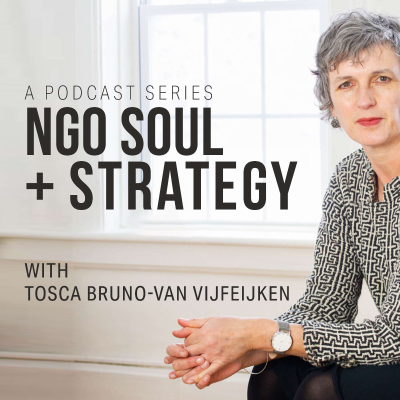
NGO Soul + Strategy
englanti
Talous & ura
Rajoitettu tarjous
1 kuukausi hintaan 1 €
Sitten 7,99 € / kuukausiPeru milloin tahansa.
- Podimon podcastit
- Lataa offline-käyttöön
Lisää NGO Soul + Strategy
Welcome to my podcast NGO Soul + Strategy – a podcast for leaders of NGOs and other philanthropic organizations who are not satisfied with the status quo, are ready to look change right in the eye and who see themselves as leader-as-learner.
Kaikki jaksot
97 jaksot096: Leading Change at Scale: Oxfam International’s Journey with Amitabh Behar
Summary In this final episode of NGO Soul + Strategy, Tosca Bruno-van Vijfeijken sits down with Amitabh Behar [https://www.linkedin.com/in/amitabh-behar-66368a319/], Executive Director of Oxfam International [https://www.linkedin.com/company/oxfam-international/posts/?feedView=all]—one of the most recognized and influential global NGOs. Together, they explore what it means to lead transformative change inside a large, complex confederation while navigating a shifting political, economic, and cultural landscape. Their conversation spans Oxfam’s ongoing change journey, its efforts to become a truly global organization rooted in legitimacy and equity, and the leadership lessons Amitabh has learned along the way. This episode is a fitting finale to the podcast—bringing together the themes of leadership, legitimacy, and adaptation that have defined Tosca’s work and this show. Amitabh Bio * Executive Director of Oxfam International * Former CEO of Oxfam India * Former Executive Director of the National Foundation for India * Former Executive Director of the National Center for Advocacy Studies We Discuss * Oxfam’s decades-long transformation journey and its confederated model of global affiliates * The rewards and tradeoffs of shifting decision-making power to the Global South * The political dimensions of leading large-scale organizational change * Balancing legitimacy, agility, and complexity in global NGOs * The use (and risks) of academic or ideological language in public communication * The critical question: should global NGOs narrow their roles for sharper impact? * Amitabh’s reflections on AI, digital rights, and Oxfam’s 2030 strategy * Leadership lessons for navigating power, resistance, and renewal Quotes > “The world still needs Oxfam—with its courage to question power, and its willingness to transform itself.” > “Leadership is not just about holding power; it’s about sharing it, even when it feels uncomfortable.” Resources Amitabh's LinkedIn Page [https://www.linkedin.com/in/amitabh-behar-66368a319/]
095: Time and Talent: Navigating the Nonprofit Sector’s Greatest Strategic Assets with Doug Trout
Summary In this episode, I am joined by Doug Trout [https://www.linkedin.com/in/doug-trout-8253156/], CEO of DRi Waterstone Human Capital, to explore how nonprofit organizations can better invest in, manage, and retain their people. From executive recruitment to culture-building and burnout, this conversation takes a deep dive into what it really takes to thrive in today’s complex nonprofit landscape. Bio * CEO of DRi Waterstone Human Capital, a firm serving nonprofits with leadership development, talent recruitment as well as executive search * DRi Waterstone offers this valuable service to nonprofits, associations, foundations and social impact orgs in US * Before his leadership position in Dri Waterstone, Dough worked at the Montpelier Foundation and at the University of Virginia as an administrator, among others. We Discuss * Why "time and talent" are the sector’s most valuable—and most constrained—strategic assets * The disconnect between what nonprofits say about valuing their people and what they actually invest in * How burnout, moral injury, and emotional fatigue are reshaping talent practices * What skills today’s leadership teams need to build truly inclusive and agile cultures * What nonprofit boards are getting right—and wrong—about talent investment * Best practices for working with executive search firms and how to make the most of that investment Quotes > “We talk about valuing people, but how often do we fund what we say we value?” > “If talent is a strategic asset, we need to start treating it like one—from the board level down.” Resources Doug Trout on LinkedIn [https://www.linkedin.com/in/doug-trout-8253156/] DRi Waterstone Human Capital [https://driwaterstonehc.com/]
094. Breaking the Barriers to Innovation: Carlos Simon on Organizational Culture & Change in NGOs
Summary Innovation is often treated as a buzzword—but few nonprofit leaders take a hard look at the cultural, structural, and leadership obstacles that keep it from taking root. In this episode, Tosca talks with Carlos Simon, an innovation strategist and longtime leader at World Vision, about what it really takes to build innovation-ready organizations. From internal mindsets to outdated processes, they explore what’s getting in the way—and what to do about it. Guest Bio: * CEO of World Vision Costa Rica and iSmart360 * Director of Data Science and former Regional Director of BD & Marketing at World Vision * Innovation strategist with 25+ years at World Vision International (WVI) * Author of a forthcoming framework on the 7 stages of organizational innovation maturity We Discuss: * Why innovation is not the same as continuous improvement—and why that matters * The cultural and structural obstacles that slow down innovation in large NGOs * How Carlos developed a framework that identifies 7 distinct organizational "zones" of innovation capacity * The importance of removing outdated processes to truly make space for new ideas * Why leaders must address internal “friction” as much as they focus on promoting new ideas * How senior leadership mindsets—like overconfidence or premature solution bias—can block innovation * The role of flat structures, strategic alignment, and client focus in driving real innovation Quotes > “You cannot have a disruptive vision and then treat it as a continuous improvement plan.” > > “Innovation doesn’t fail because of a lack of ideas—it fails because of internal resistance.” Resources Organizational innovation index with exponential factor [https://www.dropbox.com/scl/fi/0g2ow47plo84qf6b3xim6/organizational-innovation-index-with-exponential-factor-DRAFT-CSimon.pdf?rlkey=3v5ss1vqkmgr18zs05ztzu3i9&st=1e3i84nr&dl=0]
093. Feminist Leadership in Action: A Conversation with Jayanta Bora
Summary: What does it really mean to lead through a feminist lens? In this episode of NGO Soul + Strategy, I sit down with Jayanta Bora, a seasoned People & Culture expert who has helped shape leadership practices across major NGOs. Drawing from his own matrilinear upbringing and decades of experience, Jayanta explores feminist leadership not as a gendered concept but as a deliberate, power-aware leadership practice rooted in justice and equity. Jayanta's Bio: * Over 30 years of experience in People & Culture, OD, OB, and HR in the nonprofit sector. * Former Executive Director of Human Resources at Plan International. * Visiting faculty at NMIMS Global Access School and Tezpur University. * Leadership roles at Oxfam, ChildFund, and other global organizations. We Discuss: * What feminist leadership is—and what it is not. * The origins of Jayanta’s interest in feminist leadership, rooted in a matrilinear culture. * Why feminist leadership is not about gender, but about power analysis. * The seven behavioral competencies of feminist leadership: 1. Self-awareness and reflection 2. Self-care and caring for others 3. Inclusion and dismantling bias 4. Accountable collaboration 5. Sharing power and transparent decision making 6. Respectful feedback and conflict resolution 7. Courage and zero tolerance for discrimination * The need for more longitudinal research on feminist leadership effectiveness. * How feminist leadership differs from traditional or transformational leadership styles. Quotes: “If you practice feminist leadership, you have no need for DEI policies, since intersectionality of identities is baked in.” “I am a male feminist.” Resources: Jayanta's LinkedIn profile [https://www.linkedin.com/in/jayanta-bora-638230a6/] Let’s stay connected You can also watch this episode on YouTube [https://youtu.be/A33mpDIakqY] and subscribe to be the first to know when new episodes or other thought pieces are released. Have a challenge or opportunity in your nonprofit or philanthropic organization that you'd like to explore? Feel free to reach out to Tosca directly at tosca(at)5oaksconsulting(dot)org. And if you’d like more insights on nonprofit leadership, organizational change, and culture, you can follow Tosca on LinkedIn [https://www.linkedin.com/in/toscabrunovanvijfeijken/].
092. How Culture Is Reality: Rethinking NGO Safeguarding with Andrew Henck
In this episode, I speak with Andrew Henck, a scholar-practitioner whose recent PhD research offers a nuanced take on organizational culture in humanitarian NGOs. Together, we explore how culture goes far beyond shared values—it is a lens through which organizations make sense of their reality. They also examine what this means for safeguarding, accountability, and leadership in NGOs, especially amid increasing scrutiny and systemic change. Guest’s Bio * Lecturer at Glasgow Caledonian University * PhD in Leadership Studies, University of San Diego * Former People & Culture leader with World Vision in Papua New Guinea * Coach, consultant, and certified LEGO® SERIOUS PLAY® facilitator We Discuss * What the Competing Values Framework reveals about NGO culture * Andrew’s four-phase model of cultural consciousness * Why safeguarding policies fall short without deeper cultural insight * The difference between “organizations having culture” and “organizations being culture” * How to apply a developmental view of culture to real-world leadership challenges * Why boards and regulators often miss key dynamics in NGO culture Quotes “Culture is not just about values. It’s how people make sense of reality.” “Organizations are not just entities with cultures—they are cultures.” Resources * Andrew's LinkedIn Page [https://www.linkedin.com/in/andrewhenck/] * Enjoy my essay related to todays topic: Can Organizational Culture Help Explain Recent INGO Scandals? [https://5oaksconsulting.org/2019/11/11/can-organizational-culture-help-explain-recent-ingo-scandals/] Let’s stay connected You can also watch this episode on YouTube [https://youtu.be/yWUrzPplBF0] and subscribe to be the first to know when new episodes or other thought pieces are released. Have a challenge or opportunity in your nonprofit or philanthropic organization that you'd like to explore? Feel free to reach out to Tosca directly at tosca(at)5oaksconsulting(dot)org. And if you’d like more insights on nonprofit leadership, organizational change, and culture, you can follow Tosca on LinkedIn [https://www.linkedin.com/in/toscabrunovanvijfeijken/].
Valitse tilauksesi
Rajoitettu tarjous
Premium
Podimon podcastit
Lataa offline-käyttöön
Peru milloin tahansa
1 kuukausi hintaan 1 €
Sitten 7,99 € / kuukausi
Premium
20 tuntia äänikirjoja
Podimon podcastit
Lataa offline-käyttöön
Peru milloin tahansa
30 vrk ilmainen kokeilu
Sitten 9,99 € / month
Premium
100 tuntia äänikirjoja
Podimon podcastit
Lataa offline-käyttöön
Peru milloin tahansa
30 vrk ilmainen kokeilu
Sitten 19,99 € / month
Vain Podimossa



Suosittuja äänikirjoja


















1 kuukausi hintaan 1 €. Sitten 7,99 € / kuukausi. Peru milloin tahansa.