Neurocareers: Doing the Impossible!
inglés
Tecnología y ciencia
Empieza 7 días de prueba
$99 / mes después de la prueba.Cancela cuando quieras.
- 20 horas de audiolibros al mes
- Podcasts solo en Podimo
- Podcast gratuitos
Acerca de Neurocareers: Doing the Impossible!
Unlock the secrets of a career in neuroscience and neurotechnologies with our neuron-packed podcast! From inspiring success stories to cutting-edge industry advancements, we've got it all. Join us as we chat with exclusive guests and uncover the keys to thriving in this dynamic field. Plus, we'll dive into some mind-blowing topics like neuroenhancement, brain-computer interfaces, and the future of brain-based technologies. Whether you're just starting out or looking to take your career to the next level, this is the podcast for you. So, come along for the ride and discover your unique path in neuroscience with us! Hosted by The Institute of Neuroapproaches LLC and its founder, Milena Korostenskaja, Ph.D. Don't forget to check out our website https://www.neuroapproaches.org/ and subscribe to our newsletter https://www.neuroapproaches.org/neurocareers-news for even more fun and engaging insights and updates.
Todos los episodios
123 episodios
Complex Tactile Feedback for Brain-Controlled Bionic Hand with Giacomo Valle, PhD
What if a bionic hand could move with your thoughts and also let you feel edges, shapes, and even motion across your skin? In this special episode of the Neurocareers: Doing the Impossible! BCI Award Series, host Dr. Milena Korostenskaja sits down with Dr. Giacomo Valle, assistant professor at Chalmers University of Technology and 1st place winner of the 2024 BCI Award, to explore his groundbreaking research on restoring complex touch through brain-controlled bionic hands. Giacomo takes us on a journey from his early work with peripheral nerve stimulation in amputees to today's intracortical microstimulation of the somatosensory cortex, where participants experience naturalistic sensations of edges, motion, and even shapes. Along the way, he draws fascinating parallels between visual cortical prosthetics and tactile neuroprosthetics—showing how insights in one field can spark breakthroughs in the other. The episode also honors the legacy of his late mentor, Professor Sliman Bensmaia, whose pioneering contributions to the science of touch continue to shape the field. Giacomo shares a moving story from the first fingertip implant experiments, capturing the emotional moment when participants once again felt through artificial stimulation. We also dive into new research overturning old beliefs about brain reorganization after amputation. Long thought to cause cortical maps to shift, new longitudinal studies reveal that body representations in the brain remain remarkably stable—even decades after limb loss. This discovery opens new doors for amputees and the future of neuroprosthetics. 🌍 Whether you are a researcher, student, or simply curious about the future of neuroscience and technology, this conversation offers a rare inside look at how science is giving people back one of the most human experiences: the sense of touch. 🎧 Tune in to discover: * How brain implants recreate complex tactile sensations * Why direct cortical stimulation often feels more natural than peripheral approaches * The inspiring intersection between vision and touch neuroprosthetics * What stable cortical maps mean for amputees and future prosthetic design * Giacomo's career path, advice for young neurotech researchers, and his vision for the future ✨ And make sure to attend the upcoming BCI Award Ceremony 2025, where Dr. Giacomo Valle will serve as jury chair—celebrating the next wave of world-changing breakthroughs in brain-computer interfaces. BCI Award is sponsored and supported by g.tec medical engineering, Austria. About the Podcast Guest: Giacomo Valle, Assistant Professor in Bionics at Chalmers University of Technology, Head of the Neural Bionics Lab (https://www.neuralbionicslab.com/ [https://www.neuralbionicslab.com/]). - Lab: The overall scientific goal is to investigate how the natural human sensorimotor system is encoding relevant information for expressing flexible behavior and to create models able to unveil the underlying neural mechanisms. The overall biomedical goal is to engineer neuroprosthetic devices leveraging how understanding of the natural biological system in order to improve the medical condition of people with neurological impairments. -The study [https://www.science.org/doi/10.1126/science.adq5978]: Targeted brain stimulation is a promising approach for restoring the sense of touch in individuals with prosthetic hands. However, current protocols fail to mimic the natural richness of information about objects. Valle et al. developed and assessed in individuals with spinal cord injury some intracortical microstimulation approaches able to deliver enriched somatosensory percepts similar to those evoked in natural touch, including the sensations of edges, convex and concave curves, and motion (see the Perspective by prof Paul Marasco [https://www.science.org/doi/10.1126/science.adu7929]). Appropriate spatiotemporal stimulation has the potential to evoke complex somatosensorial experiences.' - Team: Cortical Bionics Research Group [https://www.corticalbionics.com/] with the special mention to Prof. Sliman Bensmaia (who unexpectedly passed away in August 2023) for his incredible support, inspiring brainstorms, and unique passion during the study. Prof. Bensmaia rigorously investigated these features of natural touch in both humans and monkeys during his career. He inspired and pushed us to leverage what we learned from touch encoding to shape new ICMS paradigms in the context of human BCI. - Participants: We thank the participants for their generous contribution to the advancement of science. BCI Pioneers Coalition [https://bcipioneers.org/]. About the Podcast Host: The Neurocareers podcast is brought to you by The Institute of Neuroapproaches (https://www.neuroapproaches.org/ [https://www.neuroapproaches.org/]) and its founder, Milena Korostenskaja, Ph.D. (Dr. K), a career coach for people in neuroscience and neurotechnologies. As a professional coach with a background in neurotech and Brain-Computer Interfaces, Dr. K understands the unique challenges and opportunities job applicants face in this field and can provide personalized coaching and support to help you succeed. Here's what you'll get with one-on-one coaching sessions from Dr. K: * Identification and pursuit of career goals * Guidance on job search strategies, resume, and cover letter development * Neurotech / neuroscience job interview preparation and practice * Networking strategies to connect with professionals in the field of neuroscience and neurotechnologies * Ongoing support and guidance to help you stay on track and achieve your goals You can always schedule a neurocareer consultation/coaching session with Dr. K at https://neuroapproaches.as.me/free-neurocareer-consultation [https://neuroapproaches.as.me/free-neurocareer-consultation] Subscribe to our Nerocareers Newsletter to stay on top of all our cool neurocareers news at updates https://www.neuroapproaches.org/neurocareers-news [https://www.neuroapproaches.org/neurocareers-news] #BrainComputerInterface #BCI #Neuroprosthetics #BionicHands #SyntheticTouch #ComplexTactilePerception #IntracorticalMicrostimulation #ICMS #SomatosensoryCortex #Neurotechnology #NeuralInterfaces #NeuralEngineering #NeurotechCareers #FutureOfNeurotech #BrainControlledProsthetics #RestoringTouch #NeuroscienceCareers #BCIAward #NeurocareersPodcast #DoingTheImpossible #GiacomoValle #MilenaKorostenskaja
How the Brain Knows It's Wrong: Endogenous Error Detection in BCIs with Camille Gontier, PhD
🧠 What if your brain could realize it made a mistake before anyone else notices? Can a brain-computer interface (BCI) detect when you're going off track—and correct itself in real time? In this compelling episode of Neurocareers: Doing the Impossible!, we sit down with Camille Gontier, PhD, to explore his BCI Award–nominated project: Endogenous modifications in M1 activity allow online error detection and correction in human BCI, developed at the Rehab Neural Engineering Labs, University of Pittsburgh. Camille shares how his team used intracortical recordings from the primary motor cortex (M1) to decode internal error signals—enabling a BCI system to slow down or stop unintended movements before they fully unfold. Discover how this real-time, feedback-free correction method could revolutionize precision in BCI applications, from neuroprosthetics to assistive technologies. 🔍 We dive into: * How error detection works at the neural level—even before a mistake happens * The design and implementation of a real-time error-sensing system * What makes this work a translational leap in human BCI research * Why this approach is especially powerful for tasks requiring high accuracy But this episode goes beyond the tech. Camille also shares: * 💼 His unconventional path—from space engineering at Airbus to closed-loop neurotech * 📚 His best advice for aspiring BCI researchers (hint: start with math and physics) * 🏆 Tips on preparing a BCI Award submission—and why it's worth doing even if you don't win Whether you're a student, a researcher, or just fascinated by the future of brain-machine interfaces, this episode is packed with insight, humility, and innovation. 🎧 Listen now to learn how the brain knows it's wrong—and how that knowledge is reshaping BCI performance. 📍 Find this and other episodes at 🔗 www.neuroapproaches.org/podcast [https://www.neuroapproaches.org/podcast] 🎧 Also on Apple Podcasts, Spotify, YouTube, and all major platforms. About the Podcast Guest: Camille Gontier is a neuroengineer and brain-computer interface (BCI) researcher whose work bridges space engineering, neuroscience, and neural decoding. He holds a Master's degree in space engineering from ISAE-Supaéro (Toulouse, France), with a dual diploma from HEC Paris, and a second Master's degree in neuroscience from ENS Ulm (Paris, France). During his graduate studies, he completed research placements at the French Space Agency (CNES) and the Center for Neuroprosthetics at EPFL in Lausanne, Switzerland. After two years working in industry as a development engineer at Airbus Defence and Space, Camille transitioned fully into neuroscience, earning his PhD in theoretical neuroscience (insigni cum laude) at the University of Bern under the supervision of Prof. Jean-Pascal Pfister. Supported by a Postdoc Mobility grant from the Swiss National Science Foundation, he joined the Rehab Neural Engineering Labs (RNEL) at the University of Pittsburgh, where he worked with Prof. Jennifer Collinger on invasive BCI systems for motor control and error detection. As of June 2025, Camille is a tenured faculty member (ISFP) at Inria, the French National Institute for Research in Digital Science and Technology. His current research focuses on closed-loop non-invasive BCIs for applications in psychiatric disorders, combining EEG, TMS, and adaptive neurotechnologies. 🔗 Learn more at: https://camillegontier.github.io/ [https://camillegontier.github.io/] About the Podcast Host: The Neurocareers podcast is brought to you by The Institute of Neuroapproaches (https://www.neuroapproaches.org/ [https://www.neuroapproaches.org/]) and its founder, Milena Korostenskaja, Ph.D. (Dr. K), a career coach for people in neuroscience and neurotechnologies. As a professional coach with a background in neurotech and Brain-Computer Interfaces, Dr. K understands the unique challenges and opportunities job applicants face in this field and can provide personalized coaching and support to help you succeed. Here's what you'll get with one-on-one coaching sessions from Dr. K: * Identification and pursuit of career goals * Guidance on job search strategies, resume, and cover letter development * Neurotech / neuroscience job interview preparation and practice * Networking strategies to connect with professionals in the field of neuroscience and neurotechnologies * Ongoing support and guidance to help you stay on track and achieve your goals You can always schedule a neurocareer consultation/coaching session with Dr. K at https://neuroapproaches.as.me/free-neurocareer-consultation [https://neuroapproaches.as.me/free-neurocareer-consultation] Subscribe to our Nerocareers Newsletter to stay on top of all our cool neurocareers news at updates https://www.neuroapproaches.org/neurocareers-news [https://www.neuroapproaches.org/neurocareers-news] #BCI #BrainComputerInterface #Neurotech #CamilleGontier #Neurocareers #NeuralDecoding #IntracorticalBCI #ErrorDetection #BCIAward #Neuroscience #BrainTech #MotorCortex #AssistiveTech #Neuroengineering
Neurotech for Cognitive Health & Brainspan Support with Ramses Alcaide, PhD, CEO of Neurable
How can brain-computer interfaces become everyday tools for optimizing cognitive health, performance, and longevity? In this episode of Neurocareers: Doing the Impossible!, we speak with Dr. Ramses Alcaide, CEO and co-founder of Neurable, a pioneering neurotechnology company developing scalable, software-based BCI solutions designed to integrate seamlessly into everyday devices—from headphones to helmets to future AR wearables. Ramses shares how Neurable's technology—originally born from his PhD research—enables users to track brain states like attention, fatigue, anxiety, and even brain age, offering real-time feedback to enhance mental performance and detect early signs of cognitive decline. Imagine a future where your headphones can signal when you're burning out, optimize your learning schedule, or even catch early neural markers of Alzheimer's before symptoms begin. That future is already being built—and it's wearable. We also explore essential career advice for those entering the neurotech space. Ramses offers candid insights on: * What to study (hint: signal processing and hard math), * Whether to pursue a PhD if you're aiming to launch a startup, * How to break into the industry without a neuroscience background, * What traits Neurable looks for when hiring—and why personal projects matter more than polished resumes. Whether you're building brain-aware tech or dreaming of launching your own neurotech company, this episode will inspire you to think differently, work smarter, and aim higher. Chapters 00:00:02 - Transforming Childhood Dreams into Neurotechnology 00:03:43 - Advancements in Brain-Computer Interfaces 00:13:08 - Tracking Sleep and Brain Performance 00:15:33 - Early Detection of Health Changes 00:17:51 - Exploring Meditation Apps and Techniques 00:20:42 - Neurotechnology and Scalable Research Insights 00:25:17 - Evolution of Wearable Neurotechnology 00:33:31 - Customer-Driven EEG Technology Development 00:35:32 - Neurotech Adoption and Design Challenges 00:39:13 - Career Advice in Neurotechnology 00:41:57 - Importance of Challenging Studies 00:45:42 - Breaking Records in Neurotech Careers 00:49:43 - Finding the Right Candidates 00:51:51 - Transitioning to Neurotech Careers 00:58:59 - Challenges in Neurotechnology Startups 01:07:48 - Teamwork and Innovation in Neurotechnology 01:11:57 - Exploring Opportunities in Neurotechnology About the Podcast Guest: Dr Ramses Alcaide is the CEO and Co-Founder of Neurable, a brain-computer interface company developing neurotechnology that allows users to control devices with their minds. He holds a PhD in neuroscience from the University of Michigan and has been recognized as a Forbes Next 1000 entrepreneur and a two-time winner of the Neuroscience Innovator Award. Connect with Dr. Alcaide through LinkedIn: https://www.linkedin.com/in/pharoramses/ [https://www.linkedin.com/in/pharoramses/] Learn about Dr. Alcaide work at Neurable and their products: https://www.neurable.com/ [https://www.neurable.com/] About the Podcast Host: The Neurocareers podcast is brought to you by The Institute of Neuroapproaches (https://www.neuroapproaches.org/ [https://www.neuroapproaches.org/]) and its founder, Milena Korostenskaja, Ph.D. (Dr. K), a career coach for people in neuroscience and neurotechnologies. As a professional coach with a background in neurotech and Brain-Computer Interfaces, Dr. K understands the unique challenges and opportunities job applicants face in this field and can provide personalized coaching and support to help you succeed. Here's what you'll get with one-on-one coaching sessions from Dr. K: * Identification and pursuit of career goals * Guidance on job search strategies, resume, and cover letter development * Neurotech / neuroscience job interview preparation and practice * Networking strategies to connect with professionals in the field of neuroscience and neurotechnologies * Ongoing support and guidance to help you stay on track and achieve your goals You can always schedule a free neurocareer consultation/coaching session with Dr. K at https://neuroapproaches.as.me/free-neurocareer-consultation [https://neuroapproaches.as.me/free-neurocareer-consultation] Subscribe to our Nerocareers Newsletter to stay on top of all our cool neurocareers news at updates https://www.neuroapproaches.org/neurocareers-news [https://www.neuroapproaches.org/neurocareers-news]
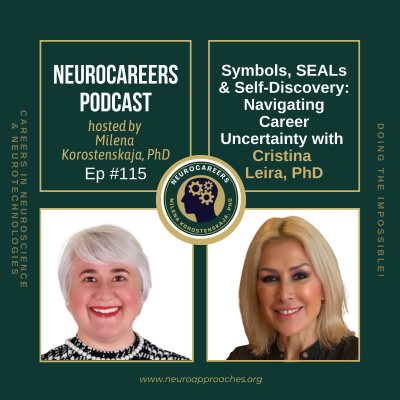
Symbols, SEALs & Self-Discovery: Navigating Career Uncertainty with Cristina Leira, PhD
What does it take to shape a career that bridges neuroscience, national defense, and the timeless power of symbols—while navigating the upheavals life throws your way? What happens when the career you've spent decades building suddenly disappears? How do you rebuild your identity when what you do is no longer who you are? In this thought-provoking episode, we welcome Cristina Leira, PhD—a multilingual psychologist, educator, and researcher whose career has spanned continents, disciplines, and elite military units. From translating for Argentina's Air Traffic Control Training Center to teaching Navy SEALs how to communicate and connect in high-stakes missions, Cristina's story is one of continuous reinvention, reflection, and quiet resilience. 🔍 Cristina shares how: * Growing up lonely in Buenos Aires, she found companionship in books and symbols before she could even read. * Her curiosity led her to study linguistics, psychology, and art—and eventually work with Naval Special Warfare for over 25 years. * She built a transformative language program for Navy SEALs using three powerful ingredients: grammar, tailored vocabulary, and cultural empathy. * Her signature approach fostered not only understanding but also human connection between operatives and the communities they served. * After the sudden defunding of her program, Cristina was forced to confront a hard truth: "I had equated who I was with what I did." In the months that followed, she came to embrace a deeper understanding—we are who we are, not what we do—reclaiming her voice through writing, research, and reflection. * She completed a PhD focused on the power of religious symbols to help people cope with trauma and loss—and is now co-authoring a 12-volume series on global symbolism through the lens of psychology and neuroscience. 📚 Cristina also discusses how reading remains her lifelong compass and daily ritual—starting each day with classical music, meaningful quotes, and quiet reflection to keep her antenna for life's signals tuned and strong. ✨ If you're facing a career crossroads, wondering how to move forward after unexpected change, or simply passionate about the brain, behavior, and meaning-making—this episode offers timeless insight, practical wisdom, and a reminder that every day is a chance to begin again. 🎧 Tune in to hear how Cristina Leira, PhD, is redefining success, resilience, and what it means to truly connect—across languages, disciplines, and human hearts. Chapters 00:00:02 - Exploring Symbols and Artistic Expression 00:05:42 - Childhood Curiosity and Symbolism 00:09:47 - Childhood Loneliness and Its Impact 00:13:17 - Teaching Spanish to Navy Seals 00:15:38 - Adapting Language Learning for Navy Seals 00:18:08 - Integrating Culture in Language Training 00:23:19 - Embracing Uncertainty and Intuition 00:27:23 - Finding Solace in Early Mornings 00:30:33 - Embracing Change and Personal Growth 00:33:36 - Mental Health and Personal Growth Journey 00:36:12 - Spiritual Moments and Healing Journeys 00:40:43 - Symbols Helping Through Adversity 00:44:26 - Adapting to Financial Insecurity 00:47:38 - Adapting to Job Loss and AI 00:59:00 - Instructor Challenges and Solutions 01:03:12 - Lessons on Respect and Communication 01:08:55 - Developing a Personalized Food App 01:21:28 - Resources for Neurocareer Development About the Podcast Guest: Born and raised in vibrant Buenos Aires, Argentina, Cristina Leira, Ph.D., has spent her life at the crossroads of diverse cultures and languages. Fluent in Spanish, English, French, Italian, and Portuguese, her career began as an educator and translator for the Argentine Air Traffic Control Training Center, and later, she brought her expertise to the U.S. Department of Defense. With a Ph.D. in Psychology, a Master's in Applied Linguistics, and graduate studies in Public Translation and Interpretation, Cristina's work combines the best of neuroscience, cognition, and instruction. Her research focuses on using healthy choices, neuroscience insights, and spirituality as tools for navigating life's challenges and enhancing satisfaction. Cristina is dedicated to empowering people to transform their lives. Whether as a researcher, author, speaker, or consultant, her mission is to help others bridge cultural and linguistic divides while unlocking the full potential of the human mind. Cristina's book on The Transformative Power of Symbolism and Religious Teachings through the Lens of Psychology [https://www.amazon.com/dp/B0DTRZTWWR?ref=cm_sw_r_ffobk_cp_ud_dp_X0S25H27QHT1Y6HFHJ6F&ref_=cm_sw_r_ffobk_cp_ud_dp_X0S25H27QHT1Y6HFHJ6F&social_share=cm_sw_r_ffobk_cp_ud_dp_X0S25H27QHT1Y6HFHJ6F&skipTwisterOG=1&bestFormat=true&newOGT=1] Connect with Cristina on LinkedIn: https://www.linkedin.com/in/drcristinaleira/ [https://www.linkedin.com/in/drcristinaleira/] About the Podcast Host: The Neurocareers podcast is brought to you by The Institute of Neuroapproaches (https://www.neuroapproaches.org/ [https://www.neuroapproaches.org/]) and its founder, Milena Korostenskaja, Ph.D. (Dr. K), a career coach for people in neuroscience and neurotechnologies. As a professional coach with a background in neurotech and Brain-Computer Interfaces, Dr. K understands the unique challenges and opportunities job applicants face in this field and can provide personalized coaching and support to help you succeed. Here's what you'll get with one-on-one coaching sessions from Dr. K: * Identification and pursuit of career goals * Guidance on job search strategies, resume, and cover letter development * Neurotech / neuroscience job interview preparation and practice * Networking strategies to connect with professionals in the field of neuroscience and neurotechnologies * Ongoing support and guidance to help you stay on track and achieve your goals You can always schedule a free neurocareer consultation/coaching session with Dr. K at https://neuroapproaches.as.me/free-neurocareer-consultation [https://neuroapproaches.as.me/free-neurocareer-consultation] Subscribe to our Nerocareers Newsletter to stay on top of all our cool neurocareers news at updates https://www.neuroapproaches.org/neurocareers-news [https://www.neuroapproaches.org/neurocareers-news]
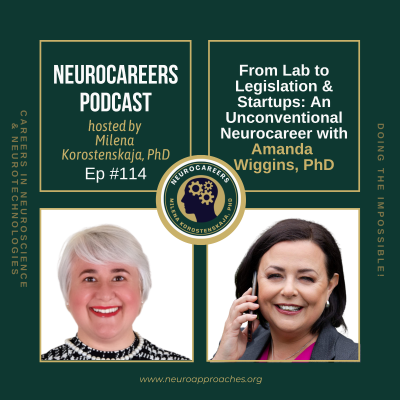
From Lab to Legislation and Startups: An Unconventional Neurocareer with Amanda Wiggins, PhD
What does it look like to take a neuroscience degree far beyond the lab? In this episode, we explore a career path that crosses scientific research, government regulation, and biotech entrepreneurship with Dr. Amanda Wiggins, CEO of The cGP Lab. Amanda began her career investigating neurodegeneration and cortical spreading depression. Over time, her passion for real-world impact led her into public policy—where she helped shape New Zealand's Human Tissue Act and advised on regulations for stem cell research and genetic technologies. Today, she leads a company advancing neuroprotective health supplements based on cyclic Glycine-Proline (cGP), a molecule with growing potential in aging and cognitive health. We talk about: * How to navigate transitions between academia, government, and business * The challenges of working across disciplines—and how to build confidence in new spaces * Lessons learned from leading regulatory change and scaling innovation * Amanda's work at The cGP Lab and the science behind cGP's potential in brain health * Advice for scientists who want to move into leadership, entrepreneurship, or public engagement This conversation is for anyone considering a non-linear career in neuroscience or wondering how to apply scientific training in new and meaningful ways. Chapters: 00:00:02 - Bridging Neuroscience and Biotech Innovation 00:04:06 - FDA Approval of Trofinetide for Rett Syndrome 00:07:27 - My Journey in Science and Identity 00:09:22 - Pursuing a PhD in Melbourne 00:11:55 - Choosing a PhD Topic 00:17:26 - Challenges and Motivation in PhD Journey 00:20:54 - Transition from Academia to Regulatory Work 00:22:52 - Transitioning from Academia to Policy 00:25:51 - Advising on the Human Tissue Act 00:29:18 - Advocating Biotechnology in New Zealand 00:33:51 - Regulations and Challenges in Biotechnology 00:37:49 - Newborn Blood Screening and Research Ethics 00:41:22 - Transitioning from Science to Biotech 00:46:04 - Challenges of Startup Success 00:48:34 - Journey to Neuroactive Innovation 00:55:23 - Mentorship and Startup Advice 00:58:49 - Dementia Prevention and Early Detection 01:02:03 - Exploring Alzheimer's Research Frontiers 01:06:45 - Advancing Your Neurocareer About the Podcast Guest: 📬 Connect with Dr. Amanda Wiggins on LinkedIn: https://www.linkedin.com/in/amandawiggins/ [https://www.linkedin.com/in/amandawiggins/] 📍 The cGPMAX natural supplement range: https://cgpmax.com/ [https://cgpmax.com/] The cGP Lab on Linkedin: https://www.linkedin.com/company/73800100 [https://www.linkedin.com/company/73800100] About the Podcast Host: The Neurocareers podcast is brought to you by The Institute of Neuroapproaches (https://www.neuroapproaches.org/ [https://www.neuroapproaches.org/]) and its founder, Milena Korostenskaja, Ph.D. (Dr. K), a career coach for people in neuroscience and neurotechnologies. As a professional coach with a background in neurotech and Brain-Computer Interfaces, Dr. K understands the unique challenges and opportunities job applicants face in this field and can provide personalized coaching and support to help you succeed. Here's what you'll get with one-on-one coaching sessions from Dr. K: * Identification and pursuit of career goals * Guidance on job search strategies, resume, and cover letter development * Neurotech / neuroscience job interview preparation and practice * Networking strategies to connect with professionals in the field of neuroscience and neurotechnologies * Ongoing support and guidance to help you stay on track and achieve your goals You can always schedule a free neurocareer consultation/coaching session with Dr. K at https://neuroapproaches.as.me/free-neurocareer-consultation [https://neuroapproaches.as.me/free-neurocareer-consultation] Subscribe to our Nerocareers Newsletter to stay on top of all our cool neurocareers news at updates https://www.neuroapproaches.org/neurocareers-news [https://www.neuroapproaches.org/neurocareers-news]
Elige tu suscripción
Premium
20 horas de audiolibros
Podcasts solo en Podimo
Podcast gratuitos
Cancela cuando quieras
Empieza 7 días de prueba
Después $99 / month
Sólo en Podimo







Audiolibros populares











Empieza 7 días de prueba. $99 / mes después de la prueba. Cancela cuando quieras.