Galloway Institute
English
History & religion
Limited Offer
1 month for 9 kr.
Then 99 kr. / monthCancel anytime.
- 20 hours of audiobooks / month
- Podcasts only on Podimo
- All free podcasts
About Galloway Institute
Let's talk politics, because ideas have consequences.
All episodes
31 episodes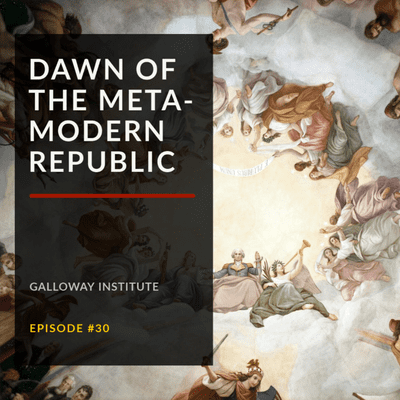
Dawn of the Meta-Modern Republic
Post-modernism was all about creating a flat moral landscape through deconstruction. Irreverence and ironic cynicism took aim at and demolished the ethical hierarchies that structured the cultural, economic, and political traditions of the West. Gone were the grand patriotic narratives and transcendent religious beliefs, our prior notions of progress were slammed into a brick wall, objectivity was torched and relativism turned honest communication into a dialectical circus, everything great was reduced and made small, all the glory contained within the human experience was unwound into a pathetic heap of trash. Fortunately for us, the glory of post-modernism walks hand in hand with its doom. Post-modernism is a negative reactive force - it can tear down systems of belief but it cannot actively provide a solid basis for building new positive systems of belief. Now that post-modernism has largely succeeded in deconstructing hierarchies and flattening our moral landscape it has created a problem it cannot solve: What now? Are we just supposed to become sloths and accept a post-modern dead-end to our individual, cultural, and political development? Of course not! The more post-modernism succeeds in tearing something down the stronger the reaction will be to build something up in its place. In this way, meta-modernism can enter the discussion as a positive reconstructive force: "Meta-modernism stands in the rubble of all knowledge humanity had amassed over thousands of years of progress. The rubble created when postmodernism smashed our collective thought to bits in the name of intellectual emancipation. With this blank slate, meta-modernism [can select] from all human knowledge and begin to construct a new grand narrative, one subject to constant discussion and consideration. It will be honest and it will push itself forward by justifying itself, not attacking the thoughts and positions of others."
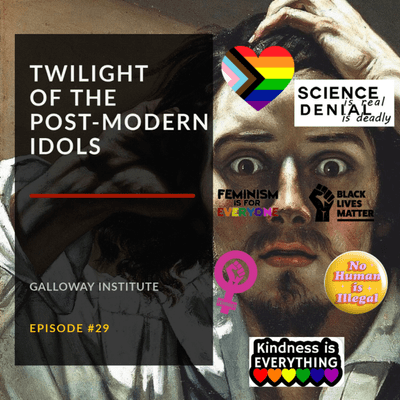
Twilight of the Post-Modern Idols
If we look around, it certainly appears that the woke narrative has ascended into a golden age. These post-modern idols seem to be towering over our society casting their shadow over everything: media, corporations, pop culture, schools, politicians, the United Nations, and even institutions like the military and the intelligence community. If there is any doubt as to how prominent the woke narrative has become, we just have to look at the severity of the social ostracism inflicted upon those who blaspheme against it. But has the golden age of wokeness and these other ideologies already come and gone? Is it possible that these narratives have slipped into the twilight years of their glory? Let us take a hammer to these post-modern idols and listen carefully to what we hear. Is there anything lasting, anything of substance inside these structures of belief? When we tap them with our hammer does a harmonious echo ring out? Or does the note fall flat? How firmly are these idols actually rooted in the minds of men? Do they wobble if we give them a push?
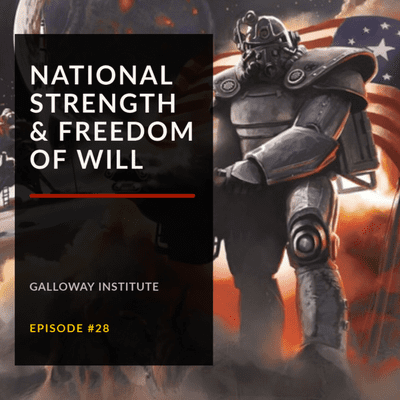
National Strength & Freedom of Will
There has been a lot of interesting commentary lately about America’s position in the world as the leading superpower. On one hand, some [https://twitter.com/Bencjacobs/status/1387921616257093633] are going back to 1917 and questioning the wisdom of the United States’ involvement in the First World War. Is it strange that America First patriots would go back and yield the 20th century to Germany but now wince at the idea of China leading the 21st? On the other hand, some [https://twitter.com/SohrabAhmari/status/1389344124860567552] are looking forward to the future and coming to terms China becoming the new global hegemon. Certainly, a case could be made that it would be preferable to live under a German-led 20th century post-WWI than a Chinese-led 21st century - but that is not the point. Why would Americans ever want to cede power to others? Why be skeptical of the superior station we held in the 20th century and now be uncertain about our role in the 21st century and beyond? How could we be comfortable with anything less than continued dominance and unparalleled strength? Citizens of strong nations must never forget the primordial reality dwelling at the bottom of politics: the strong do what they can, and the weak suffer what they must. Our government exists, in part, to make sure Americans always have more power to be in control of their destinies than less. We want to be strong so we have the freedom to act as we judge fit. We do not want to ever feel pressured to bow under the dishonorable yoke of some other nation for any reason whatsoever. It is always preferable to be a strong and prideful hegemon than a virtuous but weaker power (the hope being that virtue is easier to revitalize internally than reclaiming dominance on the world stage). The consequences of excessive pride - decadence, arrogance, and overall neglect of the critical social & political infrastructure necessary to sustain a powerful country - are certainly difficult challenges to contend with, but they are small in comparison to the consequences of being a weaker country. It is impossible to ignore the correlation between a nation’s strength and its freedom of will. Again, the strong do what they can, and the weak suffer what they must. So what is the practical takeaway from this musing? Simply this: If our nation’s unity begins to fracture and the well of public virtue begins to dry up, if we appear decadent and start losing our way, we need not add to the chaos and also willingly surrender our nation's superiority on the world stage. Instead, we should focus our efforts on revitalizing the spirit of our citizenry so the American people can continue to enjoy the freedom that only powerful nations can ever actually guarantee. Until this Renaissance arrives, some people will continue to suggest that America is just too dumb and decadent to last as a superpower. But our pride remains a force nonetheless. Maybe this arrogance will only accelerate our decline…but maybe our pride can be tapped to inspire a renewed sense of greatness. Can our pride can spark courageous actions and summon from the chaos of modern life new adventures and dazzling heroes? It is by no means clear that some other nation is ready to shine fouth while we slip into the final twilight years of our power. The fate of these United States has not yet been sealed! Perhaps others nations will not be fortunate enough to find their future glories in ruins of our collapse…perhaps we will be the ones triumphing once more.
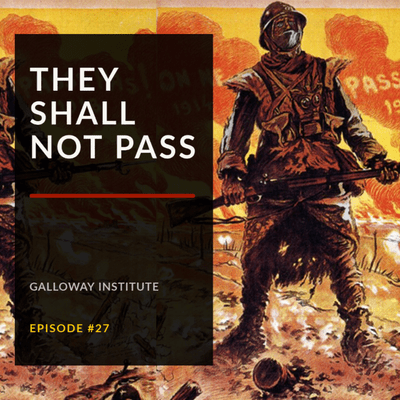
They Shall Not Pass
Last week in France, a group of retired military generals signed an open letter [https://americanmind.org/salvo/twilight-in-paris/] imploring President Macron and other members of the French government to address the “mortal dangers” facing their nation. The signatories of this letter accused their political leaders of not only failing to enforce existing laws but also dishonoring their culture and history. It is not clear at this time what will come of this. Will the generals put down their pens and draw their swords? It seems very unlikely. Recent polling found that 70% of French people felt that their country was declining, and nearly 50% agreed with the points expressed in the letter. With this broad level of support, a peaceful political solution certainly seems possible. It is important to note that these sentiments are not uniquely French. All across Western “liberal” democracies, more and more people are becoming dissatisfied with the elites leading their politics and culture. The Establishment + Woke hegemony [https://gallowayinstitute.substack.com/p/the-new-right-in-search-of-glory] seems to be more interested in deconstructing Western heritage than rallying behind it. Increasingly, Western peoples are told to look at their flags and histories and feel shame instead of pride.
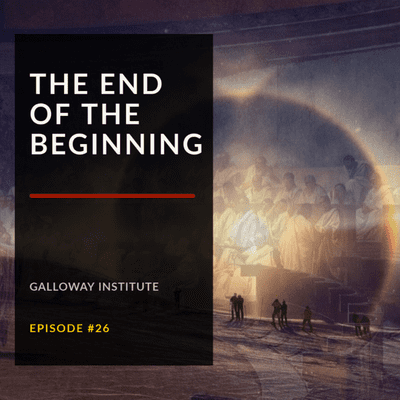
The End of the Beginning
The Galloway Institute began as a reaction to reading a quote from Cicero in our college dorm. You keep talking about those celestial phenomena, whereas I should regard what happens before our very eyes as more worthy of study. Why, do you enquire how two suns can be seen, but not why in one country there are now two people's and almost two nations? Take my advice, then, my young friends, and don't worry about the second sun. It may not exist at all; or, as it has been seen, let it exist provided it does no harm. In any case we can know nothing of such things, and even if we come to know a great deal, that kind of knowledge will not make us better or happier people. To have one Republic and one citizen body is achievable; if it isn't achieved, we are in serious trouble. But know this: if unity is brought about we shall live better and happier lives. We felt as if we caught a glimpse of the truth dwelling at the bottom of politics. Everything we thought we knew or cared about in this subject was reduced to a simple heuristic: victory in politics means achieving unity. Immediately after this discovery, our obsession with ideologies faded, and our entire view of our current political crisis was transformed. We no longer saw just a barren landscape littered with uninspiring narratives and a broken regime governed by weak lameos. Instead, we began to see an opportunity to revitalize America with a new unifying political narrative. The idea of “unity” sounds like a normie pipe-dream amidst the challenges of modern politics and the growing divide inside the spirit of the American people, but in this chaos, we saw adventure: an opportunity to face the greatest difficulty in politics and reach the highest glory. We have been chasing this idea for several years, and we feel confident that we are on to something. The podcast we began last August was the Galloway Institute’s first chapter, and now have our eyes set on taking this idea to the next level. Churchill’s old saying rings in my head: This is not the end. This is not even the beginning of the end. But it is perhaps the end of the beginning.
Choose your subscription
Most popular
Limited Offer
Premium
20 hours of audiobooks
Podcasts only on Podimo
No ads in Podimo shows
Cancel anytime
1 month for 9 kr.
Then 99 kr. / month
Premium Plus
Unlimited audiobooks
Podcasts only on Podimo
No ads in Podimo shows
Cancel anytime
Start 7 days free trial
Then 129 kr. / month
Only on Podimo























Popular audiobooks













1 month for 9 kr. Then 99 kr. / month. Cancel anytime.