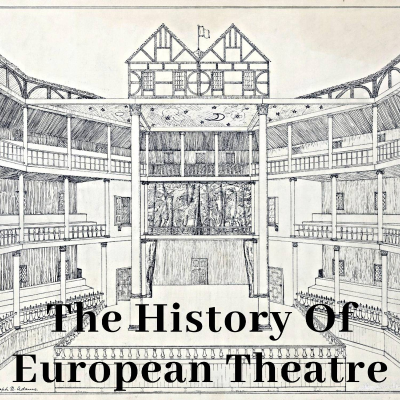
The History Of European Theatre
Engels
Cultuur & Vrije Tijd
Tijdelijke aanbieding
1 maand voor € 1
Daarna € 9,99 / maandElk moment opzegbaar.
- 20 uur luisterboeken / maand
- Podcasts die je alleen op Podimo hoort
- Gratis podcasts
Over The History Of European Theatre
A podcast tracing the development of theatre from ancient Greece to the present day through the places and people who made theatre happen. More than just dates and lists of plays we'll learn about the social. political and historical context that fostered the creation of dramatic art.This podcast uses the following third-party services for analysis: Chartable - https://chartable.com/privacy Hosted on Acast. See acast.com/privacy for more information.
Alle afleveringen
236 afleveringenIllustrated Tudors: A Conversation with Simon Sandys Winsch
Episode 197: For today’s guest episode I had the pleasure of talking to Simon Sandys Winsch, author of the Illustrated Tudor Dictionary. Given Simon’s broad knowledge of the period I took the opportunity to talk to him about some of the entries in the dictionary that give us a view of what life was like for the Elizabethan’s who went to the London theatres. We started by going back a few years into the reign of Henry 8th and discussed actions of his, the legacy of which the Elizabethans were still living with which led onto conversations about some of the struggles of the ordinary Elizabethan life. Simon Sandys Winsch graduated from Aberystwyth university with a degree in History and international politics and then became a history teacher working in various schools. It was during that career that he realised the importance of knowing topics in depth as well as the need to keep lessons informative and interesting as possible and he now puts those skills to use in writing history books. Link to the Tudor Illustrated Dictionary on Amazon UK: https://www.amazon.co.uk/Illustrated-Tudor-Dictionary-Simon-Sandys-Winsch/dp/1036101983/ref=sr_1_1 [https://www.amazon.co.uk/Illustrated-Tudor-Dictionary-Simon-Sandys-Winsch/dp/1036101983/ref=sr_1_1]? Link to the Tudor Illustrated Dictionary on Amazon US: https://www.amazon.com/Illustrated-Tudor-Dictionary-Simon-Sandys-Winsch/dp/1036101983/ref=sr_1_1 [https://www.amazon.com/Illustrated-Tudor-Dictionary-Simon-Sandys-Winsch/dp/1036101983/ref=sr_1_1]? Support the podcast at: www.thehistoryofeuropeantheatre.com [http://www.thehistoryofeuropeantheatre.com/] www.patreon.com/thoetp [http://www.patreon.com/thoetp] www.ko-fi.com/thoetp [http://www.ko-fi.com/thoetp] ---------------------------------------- Hosted on Acast. See acast.com/privacy [https://acast.com/privacy] for more information.
Cynthia’s Revels: ‘O That Joy So Soon Should Waste’
Episode 196: The origins of the play written for the court and the Children of the Chaple playing company Why this type of play is a fit for the child playing troupes The print history of the play A brief synopsis of the play Myth, Satire and Masque - the complexities with getting an understanding of the play The minor role of plot compared to words and music in the play The performance style of the boy playing companies compared to the adult companies The verbal sketching of characters as part of the satiric intent The play as part of the battle of the poets Unpicking the satiric portraits in the play The introduction of the Poetaster The masque and it’s role in the play Jonson’s coded support for the Earl of Essex in the play Early responses to the play and the longer historical view Link to European Review of History Podcast: https://podcasts.apple.com/gb/podcast/european-review-of-history-podcast/id1695812614 [https://podcasts.apple.com/gb/podcast/european-review-of-history-podcast/id1695812614] Support the podcast at: www.thehistoryofeuropeantheatre.com [http://www.thehistoryofeuropeantheatre.com/] www.patreon.com/thoetp [http://www.patreon.com/thoetp] www.ko-fi.com/thoetp [http://www.ko-fi.com/thoetp] ---------------------------------------- Hosted on Acast. See acast.com/privacy [https://acast.com/privacy] for more information.
Playing Polonius: A Conversation with Colin David Reese
Episode 195 Last time I completed my review of ‘Hamlet’, although it is probably wrong to say that one’s thoughts on Hamlet are ever complete. I am not alone in finding that every time I see the play, and it is I think, as it is for many, the Shakespeare play I have seen most often, I find something new in it to think on. To complete this quartet of episodes on the play we have the second part of my conversation with Colin David Reese about the play and in this segment, which is much shorter than the previous conversation, we focussed on the character of Polonius, although as you will near Colin also brought in other thoughts generated by the play and his knowledge of other Shakespeare plays. I certainly was not expecting to hear about ‘The Taming of the Shrew’ in the context of this conversation, but I’m glad we went there and it just illustrates how any Shakespeare conversation can lead you to all sorts of places. Before we get to Colin’s thoughts, I thought I would share with you some of the views of the play and Polonius from critics and commentators from the past. This is, of course, a tiny selection given the vast amount that has been written about Hamlet, but they are pieces that I have come across and found particularly interesting. If this piques your interest in Shakespeare criticism through time I have produced a series on that very subject for members on Patreon where I traced criticism and praise for Shakespeare from the praise poems in the First Folio to the 19th century romantics. To find out more about that just pop over to the website or to patreon.com. John Dryden Samuel Jonson Samuel Taylor Coleridge William Hazlitt A C Bradley Colin Dave Reese on Polonius Colin’s Website and access to ‘Shakespeare Unbound: A Gift to the Future’: https://shakespeareunbound.org [https://shakespeareunbound.org/] Support the podcast at: www.thehistoryofeuropeantheatre.com [http://www.thehistoryofeuropeantheatre.com/] www.patreon.com/thoetp [http://www.patreon.com/thoetp] www.ko-fi.com/thoetp [http://www.ko-fi.com/thoetp] ---------------------------------------- Hosted on Acast. See acast.com/privacy [https://acast.com/privacy] for more information.
Hamlet Part 2: ‘Something is Rotten in the State of Denmark’
Episode 194: Last time I left things hanging for Hamlet as, having seen the ghost of his father and resolved on revenge, he had seen his planning go awry as he mistakenly killed the old councillor Polonius while he hid behind a wall hanging. We have seen his daughter Ophelia begin her descent into madness, school friends Rosencrantz and Guildenstern become embroiled in Hamlet’s feigned madness and Claudius prompted into a desire to pray, having seen the players perform a piece that replicated his actions in the matter of his brother’s murder. That quick summary in no way does the play any sort of justice so please do listen to the previous two episodes on ‘Hamlet’, my look at the first half of the play and my conversation with Colin David Reese about the language in the play, if you have not done so already. I’ll be here waiting for you when you get back. Continuing a summary of the play picking up from the murder of Polonius, with Hamlet leaving and dragging the body behind him. The Character of Gertrude The female characters and the players who portrayed them The rise of boy playing troupes reflected in ‘Hamlet’ The political position of Claudius in the Danish nation The character of Osric and his role in the play The themes of death and decay The character and actions of Hamlet Hamlet as a tragic hero The graveyard scene A brief overview of the performance history of the play Support the podcast at: www.thehistoryofeuropeantheatre.com [http://www.thehistoryofeuropeantheatre.com/] www.patreon.com/thoetp [http://www.patreon.com/thoetp] www.ko-fi.com/thoetp [http://www.ko-fi.com/thoetp] ---------------------------------------- Hosted on Acast. See acast.com/privacy [https://acast.com/privacy] for more information.
Speaking Hamlet: A Conversation with Colin David Reese
Episode 193 For today’s guest episode it is a very welcome return to the podcast for Colin David Reese, who I last spoke to in early 2023, when we discussed his play ‘Shakespeare Unbound: A Gift to the Future’ and Shakespeare in general. If you missed those episodes you will find them as part of season five, first released in February and April 2023. On this occasion I asked Colin to discuss Shakespeare’s use of language, with particular reference to Hamlet, and how that language is used to create character. Colin goes in some depth into two of Hamlet’s most famous speeches from the play, so, although it is not essential you might find it useful to have a copy of the speeches to hand to follow along. You will need ‘To be or not to be’, from Act three scene one and ‘O what a rogue and peasant slave am I’ from act two scene two. We also spoke about the differences between the quarto and folio versions of the play with examples of the language from them, and as this have become a long, but very richly detailed episode, I have split it into two and will share the part dealing with characterisation and particularly Polonius after my second episode discussing the play. Colin David Reese has not only a lifetime of acting experience behind him, but a lifetime of Shakespeare study too. That started in his family life where his actor father had a Shakespeare quote for every occasion and continued with his first professional engagement when aged twelve, he played Shakespeare’s illegitimate son. Along with his many acting roles he has run his own acting company and undertaken in depth study of Shakespeare and the Commedia Dell’arte Link to RSC To Be Or Not to Be sketch on YouTube : https://www.youtube.com/watch?v=kEs8rK5Cqt8 [https://www.youtube.com/watch?v=kEs8rK5Cqt8] Link to Colin's website: https://shakespeareunbound.org [https://shakespeareunbound.org/] Support the podcast at: www.thehistoryofeuropeantheatre.com [http://www.thehistoryofeuropeantheatre.com/] www.patreon.com/thoetp [http://www.patreon.com/thoetp] www.ko-fi.com/thoetp [http://www.ko-fi.com/thoetp] ---------------------------------------- Hosted on Acast. See acast.com/privacy [https://acast.com/privacy] for more information.
Kies je abonnement
Tijdelijke aanbieding
Premium
20 uur aan luisterboeken
Podcasts die je alleen op Podimo hoort
Gratis podcasts
Elk moment opzegbaar
1 maand voor € 1
Daarna € 9,99 / maand
Premium Plus
Onbeperkt luisterboeken
Podcasts die je alleen op Podimo hoort
Gratis podcasts
Elk moment opzegbaar
Probeer 30 dagen gratis
Daarna € 11,99 / month
Alleen bij Podimo







Populaire luisterboeken











1 maand voor € 1. Daarna € 9,99 / maand. Elk moment opzegbaar.