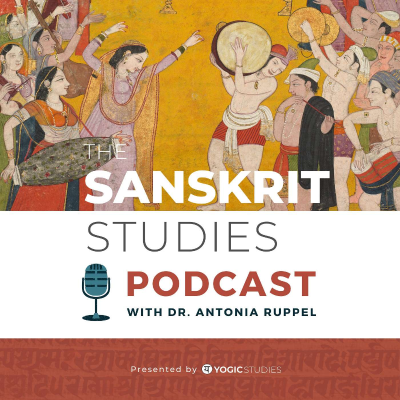
The Sanskrit Studies Podcast
inglés
Tecnología y ciencia
Empieza 7 días de prueba
$99 / mes después de la prueba.Cancela cuando quieras.
- 20 horas de audiolibros al mes
- Podcasts solo en Podimo
- Podcast gratuitos
Acerca de The Sanskrit Studies Podcast
In-depth explorations into the field of Sanskrit Studies. Featuring candid conversations and interviews with scholars of Sanskrit across the disciplines of Indology, Linguistics, Religious Studies, Philosophy, History, and more. Hosted by Dr. Antonia Ruppel.
Todos los episodios
17 episodios16. Amba Kulkarni | Sanskrit and Computers
My guest this month is Amba Kulkarni [https://sanskrit.uohyd.ac.in/faculty/amba/] from the Department of Sanskrit [https://sanskrit.uohyd.ac.in] at the University of Hyderabad, who has also been associated with IIT Kanpur [https://en.wikipedia.org/wiki/IIT_Kanpur] and the National Sanskrit University [https://en.wikipedia.org/wiki/National_Sanskrit_University]. Professor Kulkarni is best known for her work [https://sanskrit.uohyd.ac.in/scl/] linking traditional Indian linguistic theory (starting with Pāṇini [https://en.wikipedia.org/wiki/Pāṇini] and focussing on aspects such as Śabdabodha [https://dharmawiki.org/index.php/Shabda_Bodha_(शाब्दबोधः)] and Kāraka [http://www.glottopedia.org/index.php/Kāraka] theory as studied especially within the Navya-Nyāya [https://en.wikipedia.org/wiki/Navya-Nyāya]/'Neo-Logical' school of philosophy) and AI theories of Knowledge Representation [https://en.wikipedia.org/wiki/Knowledge_representation_and_reasoning] to effect computer-based cognition of Sanskrit texts. Find out more about her recent book 'Sanskrit Parsing based on the theories of Śabdabodha' here [https://dkprintworld.com/product/sanskrit-parsing/]. The article by Rick Briggs that she mentions as her inspiration to apply her Computer Science background to Sanskrit is reprinted here [https://ojs.aaai.org/aimagazine/index.php/aimagazine/article/view/466], that by Rajeev Sangal [https://faculty.iiit.ac.in/~sangal/web/] and Vineet Chaitanya [https://www.researchgate.net/profile/Vineet-Chaitanya] can be accessed here [https://aclanthology.org/C90-3005/], and there is discussion of Bhāratīkṛṣṇa Tīrtha [https://en.wikipedia.org/wiki/Bharati_Krishna_Tirtha]'s book on Vedic Mathematics here [https://en.wikipedia.org/wiki/Vedic_Mathematics]. She has collaborated extensively with Gérard Huet [https://en.wikipedia.org/wiki/G%C3%A9rard_Huet], best known in Sanskritist circles for his Sanskrit Heritage Site [https://sanskrit.inria.fr/] (part of which is the Segmenter [https://sanskrit.inria.fr/DICO/reader.fr.html]). Relating to the parsing of the sentence yānaṃ vanaṃ gacchati 'the vehicle goes to the forest', she mentions the factors śabdabodha considers essential for verbal cognition: yogyatā or mutual compatibility, ākaṅksā or expectancy and saṃniddhi or proximity (read some discussion of these here [https://www.jstor.org/stable/23447819]). More on the three types of meaning of a word (abhidhā or literal, lakṣaṇā or metaphoric/extended and vyañjanā or suggested meaning) e.g. here [http://epgp.inflibnet.ac.in/epgpdata/uploads/epgp_content/S000027PH/P001110/M016762/ET/146648833614.15.1.pdf]. If you are a Sanskritist interested in working in computational linguistics, Professor Kulkarni suggests a thorough focus in Kāvya [https://en.wikipedia.org/wiki/Kāvya]/Kāvyaśāstra [https://www.wisdomlib.org/kavyashastra], Mīmāṃsā [https://en.wikipedia.org/wiki/Mīmāṃsā], Nyāya [https://en.wikipedia.org/wiki/Nyaya] or Vyākaraṇa [https://en.wikipedia.org/wiki/Vyākaraṇa].
15. Robert Zydenbos | The Life of Sanskrit Traditions
My guest this month is Robert Zydenbos [https://en.wikipedia.org/wiki/Robert_J._Zydenbos], who is Professor of Modern Indology [https://www.indologie.uni-muenchen.de/personen/2_professoren/zydenbos/index.html]at the LMU Munich. (Full disclosure: we thus are colleagues!) His first point of contact with Indian languages and philosophies was through Collier's Encyclopaedia [https://en.wikipedia.org/wiki/Collier%27s_Encyclopedia]. It introduced him to such ideas as rebirth, a concept found in various traditions (see e.g. here [https://en.wikipedia.org/wiki/Reincarnation], here [https://en.wikipedia.org/wiki/Rebirth_(Buddhism)] or here [https://en.wikipedia.org/wiki/Metempsychosis]) His first degree was in Indian Studies at the University of Utrecht, at an institute that developed into a centre of Tantric Studies [https://en.wikipedia.org/wiki/Tantra] and that has in the meantime been closed. His teachers included Jan Gonda [https://en.wikipedia.org/wiki/Jan_Gonda], T. Goudriaan [https://www.semanticscholar.org/author/T.-Goudriaan/120329753] , Henk Bodewitz [https://en.wikipedia.org/wiki/Henk_Bodewitz], Leen van Dalen [https://www.dutchstudies-satsea.nl/deelnemers/daalen-leendert-antonius-leen/], George Chemparathy [https://www.dutchstudies-satsea.nl/deelnemers/george-chemparathy/], Kamil Zvelebil [https://en.wikipedia.org/wiki/Kamil_Zvelebil], Sanjukta Gupta [https://ochs.org.uk/dr-sanjukta-gupta/], Karel van Kooij [https://www.dutchstudies-satsea.nl/deelnemers/kooij-karel-rijk/]. He did his PhD and much subsequent work in Mysore [https://en.wikipedia.org/wiki/Mysore], where he frequently visited the university [https://en.wikipedia.org/wiki/University_of_Mysore]and the Oriental Research Institute [https://uni-mysore.ac.in/english-version/oriental-research-institute]; and whereas his early interest in Jainism brought him to Karnataka, he also studied religious currents such as Vīraśaivism [https://en.wikipedia.org/wiki/Lingayatism] and Mādhva Vaiṣṇavism [https://en.wikipedia.org/wiki/Sadh_Vaishnavism]. Through his close acquaintance with Bannanje Govindacharya [https://en.wikipedia.org/wiki/Bannanje_Govindacharya], he began working on Madhvācārya [https://en.wikipedia.org/wiki/Madhvacharya] and his writings [https://en.wikipedia.org/wiki/List_of_works_by_Madhvacharya], also those concerning the Bhagavadgītā [https://en.wikipedia.org/wiki/Bhagavad_Gita]. (The article he mentions may be found here [https://www.academia.edu/92019121/Madhva_and_the_Reform_of_Vai%E1%B9%A3%E1%B9%87avism_in_Karnataka].) He would use the SSPRG, the Sanskrit Studies Podcast Research Grant, to learn Old Javanese [https://en.wikipedia.org/wiki/Old_Javanese]. For anyone interested in learning about Sanskrit for the first time, he recommends Pierre-Sylvain Filliozat [https://fr.wikipedia.org/wiki/Pierre-Sylvain_Filliozat]'s Le sanskrit [https://www.puf.com/content/Le_sanskrit]/The Sanskrit Language [https://books.google.de/books/about/The_Sanskrit_Language.html].
14. Saroja Bhate | Vyākaraṇa and Good Teachers
My guest this month is Professor Saroja Bhate, former Professor of Sanskrit and Head of the Department of Sanskrit and Prakrit Languages [http://www.unipune.ac.in/dept/fine_arts/sanskrit_and_pakrit/sanpak_webfiles/profile.htm] at Pune University, who has published prolifically [http://worldcat.org/identities/lccn-n85103890/] on Vyākaraṇa [https://en.wikipedia.org/wiki/Vyākaraṇa]. Her first contact with Sanskrit was through the recitation of stotras [https://en.wikipedia.org/wiki/Stotra]. She was educated at Pune University and at Ṭiḷaka Mahārāṣṭra Vidyāpīṭha [http://www.tmv.edu.in/DeptBalmukund/frmBalmukundHome.aspx], and among her teachers were Pundit Vāmanaśāstrī Bhāgavata [http://worldcat.org/identities/lccn-n85103154/], T. G. Mainkar [https://www.worldcat.org/search?q=au="Mainkar,%20T.%20G."] and S. D. Joshi [https://en.wikipedia.org/wiki/Shivram_Dattatray_Joshi]. Among the texts she read during her studies are the Rāmāyaṇa [https://en.wikipedia.org/wiki/Ramayana], Mahābhārata [https://en.wikipedia.org/wiki/Mahabharata] including the Bhagavadgītā [https://en.wikipedia.org/wiki/Bhagavad_Gita], Meghadūta [https://en.wikipedia.org/wiki/Meghadūta], Raghuvaṃśa [https://en.wikipedia.org/wiki/Raghuvaṃśa], plays by Kālidāsa [https://en.wikipedia.org/wiki/Kalidasa] and Viśākhadatta [https://en.wikipedia.org/wiki/Vishakhadatta], Śiśupālavadha [https://en.wikipedia.org/wiki/Shishupala_Vadha], Kirātārjunīya [https://en.wikipedia.org/wiki/Kirātārjunīya] as well as selections from the Brāhmaṇas [https://en.wikipedia.org/wiki/Brahmana] and the Upaniṣads [https://en.wikipedia.org/wiki/Upanishads]. The linguistic texts she mentioned include Pāṇini's Aṣṭādhyāyī [https://en.wikipedia.org/wiki/Aṣṭādhyāyī], the Brahmakāṇḍa, a portion of Bhartṛhari [https://en.wikipedia.org/wiki/Bhartṛhari]'s Vākyapadīya, the Paramalaghumañjūṣā [https://archive.org/details/ParamaLaghuManjushaDr.JayaShankarLalTripathi/mode/2up], texts from the Cāndravyākaraṇa [https://archive.org/details/Liebich1902] and Kātantra [https://en.wikipedia.org/wiki/Katantra] traditions, and the works of Nāgoji (or Nāgeśa) Bhaṭṭa [https://fr.wikipedia.org/wiki/Nagoji_Bhatta], such as the Paribhāṣenduśekhara [https://www.worldcat.org/title/paribhashendushekhara/oclc/28853148]. The modern linguists she mentioned are George Cardona [https://en.wikipedia.org/wiki/George_Cardona] and Paul Kiparsky [https://en.wikipedia.org/wiki/Paul_Kiparsky]. Her advice for those embarking in the field includes learning languages and studying Mīmāṃsā [https://en.wikipedia.org/wiki/Mīmāṃsā], Nyāya [https://en.wikipedia.org/wiki/Nyaya], manuscriptology [https://en.wikipedia.org/wiki/Codicology], and symbolic logic [https://philosophy.lander.edu/logic/symbolic.html].
13 Patrick McCartney | Sanskrit in the World
My guest this month is Patrick McCartney. His written work, on Sanskrit-speaking villages, Sanskrit in the Indian census, the popular use and the politics of Yoga (and many other topics), is very conveniently linked to here [https://nanzan-u.academia.edu/PatrickSDMcCartney]. His Yogascapes project has its own website [http://www.yogascapesinjapan.com]. The Himāl article on Spoken Sanskrit he mentions is linked to here [https://www.himalmag.com/sanitising-power-spoken-sanskrit/]. His videos, including his 'A Day in our Ashram' [https://youtu.be/xZHJVkhVBPc] and the videos on his search for the Sanskrit-speaking villages, are available on his YouTube channel [https://www.youtube.com/channel/UCfGaSWlfxH4er_TsQBmSINQ/featured]. You can read more about the Sanskrit programme at Australia National University here [https://chl.anu.edu.au/study//language-study/sanskrit-studies]. (And of course there is the SSP interview with the wonderful McComas Taylor [https://www.sanskritstudiespodcast.com/1759898/8827962-1-mccomas-taylor-pura-as-open-access-and-wild-geese], the heart of Sanskrit at ANU.) The article on the 'Sanskrit Boulevard' from the Hindustan times is here [https://www.hindustantimes.com/india/sanskrit-boulevard/story-u8M0ylD1druUeSPAd404hN.html]; this [https://www.hindustantimes.com/india-news/this-bengali-family-speaks-only-sanskrit-at-home-to-keep-alive-the-ancient-language/story-Q3R57iAwwRdBN5QWtudYqI.html] is a related article. Read more about M. N. Srinivas [https://en.wikipedia.org/wiki/M._N._Srinivas] and the concept of Sanskritisation [https://en.wikipedia.org/wiki/Sanskritisation]. If you are interested in the SOAS- based Haṭha Yoga Project [http://hyp.soas.ac.uk], their website is here; this is a brief introduction to pole yoga or Mallakhamba [https://en.wikipedia.org/wiki/Mallakhamba]. The books Patrick recommends for people interested getting into the field are Asko Parpola's Roots of Hinduism [https://global.oup.com/academic/product/the-roots-of-hinduism-9780190226909] and Sheldon Pollock's Rasa Reader [https://www.degruyter.com/document/doi/10.7312/poll17390/html].
12. Andrew Ollett | Beyond Sanskrit
My guest this month is Mr Prakrit [http://www.prakrit.info], Andrew Ollett [https://salc.uchicago.edu/andrew-ollett], who teaches at the University of Chicago [https://salc.uchicago.edu] Perhaps his most well-known publication is the book 'Language of the Snakes', which you can download for free here [https://www.ucpress.edu/book/9780520296220/language-of-the-snakes]. Among his teachers were Eleanor Dickey [https://en.wikipedia.org/wiki/Eleanor_Dickey], Gary Tubb [https://salc.uchicago.edu/gary-tubb] and Sheldon Pollock [https://sheldonpollock.org] (whose book 'The Language of the Gods in the World of Men [https://www.ucpress.edu/book/9780520260030/the-language-of-the-gods-in-the-world-of-men]' Andrew mentions) He talks about his work comparing the language of Theocritus [https://en.wikipedia.org/wiki/Theocritus] with that of Prakrit poetry [http://prakrit.info/prakrit/reader.html?r=4], about the work of Mātṛceṭa [https://www.encyclopedia.com/religion/encyclopedias-almanacs-transcripts-and-maps/matcea] and Aśvaghoṣa [https://en.wikipedia.org/wiki/Aśvaghoṣa] , about the rock inscription [https://en.wikipedia.org/wiki/Junagadh_rock_inscription_of_Rudradaman] of Rudradāman, and the influence that the Sātavāhana [https://en.wikipedia.org/wiki/Satavahana_dynasty] courts had on Prakrit. Among the languages and language forms he mentions are Vedic [https://en.wikipedia.org/wiki/Vedic_Sanskrit], Pali [https://en.wikipedia.org/wiki/Pali], Apabhraṃśa [https://en.wikipedia.org/wiki/Apabhraṃśa], Gāndhārī [https://en.wikipedia.org/wiki/Gandhari_language] and Old Gujarati or Rajasthāni [https://en.wikipedia.org/wiki/Old_Western_Rājasthāni] . Among the Prakrit texts he talks about are the Gaha Sattasai [https://en.wikipedia.org/wiki/Gaha_Sattasai] (and its recent translation [https://sunypress.edu/Books/P/Poems-on-Life-and-Love-in-Ancient-India2] by Khoroche and Tieken), the Setubandha [https://medium.com/desiretothink/the-setubandha-of-pravarasena-6a1383121b8], the works of Kundakunda [https://en.wikipedia.org/wiki/Kundakunda], the Rasikaprakāśana by Vairocana, the Jain [https://en.wikipedia.org/wiki/Jain_literature] niryuktis ascribed to Bhadrabāhu [https://en.wikipedia.org/wiki/Bhadrabahu], and the use of Prakrit in Sanskrit plays [https://en.wikipedia.org/wiki/Dramatic_Prakrit]. You can find out a little more about Madhav Deshpande [https://www.sanskritstudiespodcast.com/1759898/9933527-7-madhav-deshpande-bridging-sanskrit-traditions]'s book Sanskrit and Prakrit: Sociolinguistic Issues here [https://www.jstor.org/stable/25183095]. For his Sanskrit Studies Podcast Research Grant Project, Andrew will work on Kannada [https://en.wikipedia.org/wiki/Old_Kannada]. He recommends A. K. Ramanujan's Speaking of Śiva [https://www.goodreads.com/en/book/show/389661.Speaking_of_Siva], the Daśakumāracarita [https://en.wikipedia.org/wiki/Dashakumaracharita] in Isabelle Onians' translation [https://claysanskritlibrary.org/wp-content/uploads/2021/08/10_CSL_TenYoungMen-1.pdf], Tamil Sangam [https://en.wikipedia.org/wiki/Sangam_literature] poetry and especially the Kuruntokai [https://en.wikipedia.org/wiki/Kuṟuntokai], and suggests you go read Bhavabūti's Uttararāmacarita [https://en.wikipedia.org/wiki/Uttararamacarita] right now. (And I apologize for the sounds of my cat beating up his toys in the background!)
Elige tu suscripción
Más populares
Premium
20 horas de audiolibros
Podcasts solo en Podimo
Disfruta los shows de Podimo sin anuncios
Cancela cuando quieras
Empieza 7 días de prueba
Después $99 / mes
Sólo en Podimo






















Audiolibros populares










Empieza 7 días de prueba. $99 / mes después de la prueba. Cancela cuando quieras.