
The Science of Happiness
inglés
Tecnología y ciencia
Empieza 7 días de prueba
$99 / mes después de la prueba.Cancela cuando quieras.
- 20 horas de audiolibros al mes
- Podcasts solo en Podimo
- Podcast gratuitos
Acerca de The Science of Happiness
Learn research-tested strategies for a happier, more meaningful life, drawing on the science of compassion, gratitude, mindfulness, and awe. Hosted by award-winning psychologist Dacher Keltner. Co-produced by PRX and UC Berkeley's Greater Good Science Center. Follow us on Instagram @HappinessPod.
Todos los episodios
337 episodios
Happiness Break: Make Uncertainty Part of the Process
Through poetic reflection, Yrsa Daley-Ward helps us embrace the in-between moments, reminding us that the unknown can be the very terrain where real change begins. 1. Settle into Stillness: Find a quiet space, get comfortable, and take a few slow breaths to arrive in the moment. 2. Acknowledge the Unknown: Gently notice and name any uncertainty, confusion, or emotional fog you’re feeling without needing to fix it. 3. Welcome the Silence: Allow the silence and stillness to be here, trusting it holds meaning even if it feels uncomfortable. 4. Reflect with Gentle Words: Repeat silently or write: “To love yourself through the darkness is to plant gardens at night.” 5. Feel Your Connection: Remember that many others are also sitting with uncertainty, and you are not alone in this experience. 6. Close with Compassion: Offer yourself kindness through touch or words and affirm that this pause is part of your growth. Scroll down for a transcription of this episode. Today’s Happiness Break Guide: YRSA DALEY-WARD is an award-winning poet and author of the novel, The Catch. Learn more about Yrsa here: https://yrsadaleyward.squarespace.com/ [https://yrsadaleyward.squarespace.com/] Order her book here: https://tinyurl.com/yanw6bb5 [https://tinyurl.com/yanw6bb5] Related Happiness Break episodes: Using Art As Medicine Series: https://tinyurl.com/k3mneupx [https://tinyurl.com/k3mneupx] Making Space For You: https://tinyurl.com/yk6nfnfv [https://tinyurl.com/yk6nfnfv] How To Awaken Your Creative Energy: https://tinyurl.com/4fknd8ev [https://tinyurl.com/4fknd8ev] Related Science of Happiness episodes: How Art Heals Us: https://tinyurl.com/yc77fkzu [https://tinyurl.com/yc77fkzu] Our Brains on Poetry: https://tinyurl.com/y9r9dyzd [https://tinyurl.com/y9r9dyzd] Are You Following Your Inner Compass: https://tinyurl.com/y2bh8vvj [https://tinyurl.com/y2bh8vvj] Follow us on Instagram: @ScienceOfHappinessPod [https://www.instagram.com/scienceofhappinesspod/]We’d love to hear about your experience with this practice! Share your thoughts at happinesspod@berkeley.edu or use the hashtag #happinesspod. Find us on Apple Podcasts: https://tinyurl.com/2p9h5aap [https://tinyurl.com/2p9h5aap] Help us share Happiness Break! Leave a 5-star review and share this link: https://tinyurl.com/2p9h5aap [https://tinyurl.com/2p9h5aap] Transcription: https://tinyurl.com/yckxhbja [https://tinyurl.com/yckxhbja]

Happiness Break: How Poetry Helps Us Feel and Heal
What happens in your brain when you read or write a poem? We listen to powerful poetry from you, our listeners, and uncover the neuroscience of why it helps us feel, process, and recover. Scroll down for a transcription of this episode. Today’s Happiness Break Guest: SUSAN MAGSAMEN is a Neurology professor at John Hopkins, and author of the New York Times bestseller, Your Brain On Art: How the Arts Transform Us. Find Susan’s book here: https://www.yourbrainonart.com/ [https://www.yourbrainonart.com/] Related Happiness Break episodes: Using Art As Medicine Series: https://tinyurl.com/k3mneupx [https://tinyurl.com/k3mneupx] Making Space For You: https://tinyurl.com/yk6nfnfv [https://tinyurl.com/yk6nfnfv] How To Awaken Your Creative Energy: https://tinyurl.com/4fknd8ev [https://tinyurl.com/4fknd8ev] Related Science of Happiness episodes: How Art Heals Us: https://tinyurl.com/yc77fkzu [https://tinyurl.com/yc77fkzu] Our Brains on Poetry: https://tinyurl.com/y9r9dyzd [https://tinyurl.com/y9r9dyzd] Are You Following Your Inner Compass: https://tinyurl.com/y2bh8vvj [https://tinyurl.com/y2bh8vvj] Follow us on Instagram: @ScienceOfHappinessPod [https://www.instagram.com/scienceofhappinesspod/]We’d love to hear about your experience with this practice! Share your thoughts at happinesspod@berkeley.edu or use the hashtag #happinesspod. Find us on Apple Podcasts: https://tinyurl.com/2p9h5aap [https://tinyurl.com/2p9h5aap] Transcription: https://tinyurl.com/43p9jtny [https://tinyurl.com/43p9jtny]
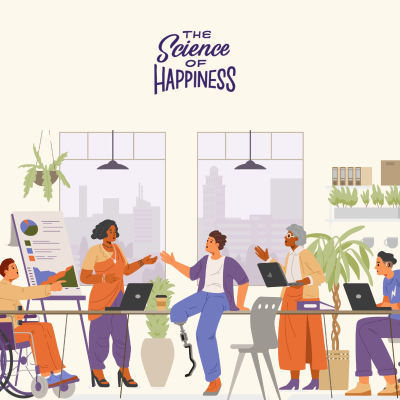
Why Work Feels Better Together
From a worker-owned restaurant in Oakland to a nonprofit built on shared leadership, we explore how collective work models can help people feel heard, valued, and more invested in their work. Summary: In this episode of The Science of Happiness, we examine how people can build cultures of care, accountability, and belonging together. Through stories from a worker-owned restaurant and insights from a leader in collective nonprofits, we share what research reveals about why collective decision-making can help teams thrive and organizations succeed. Scroll down for a transcription of this episode. Today’s Guests: NINO SERRANO AND JENABI PAREJA are the co-founders of Understory, a worker-owned and community-built restaurant in Oakland. Learn more about Understory here: https://understoryoakland.com/ [https://understoryoakland.com/] NILOUFAR KHONSARI is the co-founder of Pangea Legal Services, a nonprofit that defends immigrants facing deportation and the author of the book, Future is Collective: Effective Workplace Strategies for Building a Culture of Care. Read the book here: https://www.niloukhonsari.com/thebook [https://www.niloukhonsari.com/thebook] Related The Science of Happiness episodes: How to Talk to People You Disagree With: https://tinyurl.com/4cpm8m3a [https://tinyurl.com/4cpm8m3a] When It’s Hard to Connect, Try Being Curious: https://tinyurl.com/bde6wyu7 [https://tinyurl.com/bde6wyu7] Why Compassion Requires Vulnerability: https://tinyurl.com/yxw4uhpf [https://tinyurl.com/yxw4uhpf] Related Happiness Breaks: A Self-Compassion Meditation For Burnout: https://tinyurl.com/485y3b4y [https://tinyurl.com/485y3b4y] 5 Minutes of Gratitude: https://tinyurl.com/r6pkw2xx [https://tinyurl.com/r6pkw2xx] Making Space For You: https://tinyurl.com/yk6nfnfv [https://tinyurl.com/yk6nfnfv] Message us or leave a comment on Instagram @scienceofhappinesspod [https://www.instagram.com/scienceofhappinesspod/]. E-mail us at happinesspod@berkeley.edu or use the hashtag #happinesspod. Help us share The Science of Happiness! Leave us a 5-star review on Apple Podcasts or share this link with someone who might like the show: https://tinyurl.com/2p9h5aap [https://tinyurl.com/2p9h5aap] Transcription: https://tinyurl.com/ya9vuy4n [https://tinyurl.com/ya9vuy4n]
Happiness Break: A Meditation For When You Have Too Much To Do
Does your to-do list feel endless? Try this short, guided practice to help you reflect, reconnect, and release the pressure to do it all perfectly. How To Do This Practice: 1. Find a Comfortable Posture: Sit or stand tall with a sense of dignity, grounded, yet relaxed. 2. Take Three Cleansing Breaths: Inhale twice through the nose, then exhale slowly through the mouth. Repeat this three times to settle into the moment. 3. Scan Your Body from Head to Toe: Gently bring your attention to each part of your body, noticing sensations and letting go of any tension as you move downward. 4. Visualize Your To-Do List as Floating Bubbles: Imagine each task as a bubble above you. Observe them without judgment, simply noticing their presence. 5. Ask Reflective Questions: Is it the number of tasks that’s overwhelming, or is it fear of forgetting, failing, or letting someone down? What’s truly fueling your stress? 6. Recenter with Gratitude and Self-Compassion: Acknowledge that being needed is a form of purpose. Remind yourself that even if not everything gets done, you are still enough and already whole. Scroll down for a transcription of this episode. Explore more talks, workshops, and resources atggsc.berkeley.edu/speaking [http://ggsc.berkeley.edu/speaking]. Today’s Happiness Break Guide: KIA AFCARI is the director of Greater Good Workplaces at GGSC. Kia grounds his work in the science of well-being, prosociality, and contemplative practices and uses creative methods like “instant dance parties” and Boal-informed theater techniques to achieve results. Watch Kia’s TED Talk on reshaping diversity, equity, and inclusion here: https://tinyurl.com/483tdjp5 [https://tinyurl.com/483tdjp5] Related Happiness Break episodes: Making Space For You: https://tinyurl.com/yk6nfnfv [https://tinyurl.com/yk6nfnfv] Make Uncertainty Part of the Process: https://tinyurl.com/234u5ds7 [https://tinyurl.com/234u5ds7] Who Takes Care of You: https://tinyurl.com/5xmfkf73 [https://tinyurl.com/5xmfkf73] Related Science of Happiness episodes: Are You Following Your Inner Compass: https://tinyurl.com/y2bh8vvj [https://tinyurl.com/y2bh8vvj] How Holding Yourself Can Reduce Stress: https://tinyurl.com/2hvhkwe6 [https://tinyurl.com/2hvhkwe6] How To Show Up For Yourself: https://tinyurl.com/56ktb9xc [https://tinyurl.com/56ktb9xc] Follow us on Instagram: @ScienceOfHappinessPod [https://www.instagram.com/scienceofhappinesspod/]We’d love to hear about your experience with this practice! Share your thoughts at happinesspod@berkeley.edu or use the hashtag #happinesspod. Find us on Apple Podcasts: https://tinyurl.com/2p9h5aap [https://tinyurl.com/2p9h5aap] Help us share Happiness Break! Leave a 5-star review and share this link: https://tinyurl.com/2p9h5aap [https://tinyurl.com/2p9h5aap] Transcription: https://tinyurl.com/mrxa8bp8 [https://tinyurl.com/mrxa8bp8]
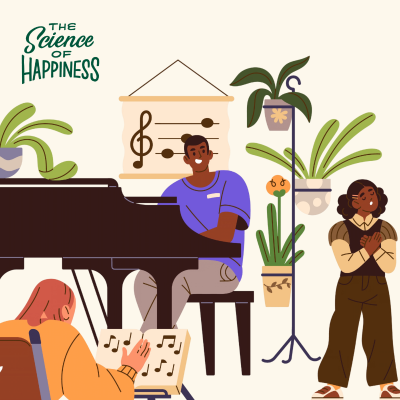
What Happens in the Brain When We Improvise
Explore the neuroscience behind musical improvisation—and what it reveals about our natural capacity for creativity. Summary: Creativity may be more natural than we think. Research on musicians and children improvising at the piano suggests that improvisation can quiet the brain’s inner critic while engaging networks linked to exploration, play, and reward. In this episode of The Science of Happiness, we look at the neuroscience of improvisation—and what a “beginner’s mind” can teach us about opening up creativity in everyday life. How To Do This Practice: 1. Choose a simple starting point: Begin with something familiar—a simple melody, rhythm, phrase, movement, or creative prompt. It could be notes on a keyboard, a beat you tap on the table, a few lines of writing, or even a movement with your body. 2. Change one small thing: Experiment by altering a single element, like the speed, mood, rhythm, or key. Small changes help spark creativity without feeling overwhelming. 3. Let go of judgment: Remind yourself there are no mistakes in improvisation, only possibilities. If something sounds unexpected, treat it as part of the exploration rather than something to fix. 4. Follow your curiosity: Notice what sounds, patterns, or ideas interest you and build on them. Let each moment guide the next instead of planning too far ahead. 5. Treat it like play: Approach improvisation with a playful mindset, the way kids experiment and explore. The goal isn’t perfection—it’s discovery and enjoyment. 6. Reflect on how it felt: Afterward, take a moment to notice how the experience affected your mood or mindset. Many people find that improvising helps them feel more relaxed, creative, and open. Scroll down for a transcription of this episode. Today’s Guests: DR. KAREN CHAN BARRETT is an Assistant Professor with a joint appointment in the Institute for Health & Aging at the UCSF School of Nursing. Learn more about Dr. Karen Chan Barrett here: https://karenchanbarrett.com/ [https://karenchanbarrett.com/] Related The Science of Happiness episodes: The Science of Singing Along: https://tinyurl.com/4nbb3v76 [https://tinyurl.com/4nbb3v76] The Science of Humming: https://tinyurl.com/4esyy6nd [https://tinyurl.com/4esyy6nd] How Music Can Hold and Heal Us: https://tinyurl.com/49svzn4v [https://tinyurl.com/49svzn4v] Related Happiness Breaks: Music to Inspire Kindness in Kids: https://tinyurl.com/yjk344rd [https://tinyurl.com/yjk344rd] A Humming Technique to Calm Your Nerves: https://tinyurl.com/mr42rzad [https://tinyurl.com/mr42rzad] A Walking Meditation: https://tinyurl.com/mwbsen7a [https://tinyurl.com/mwbsen7a] Tell us about your experience with this practice. Email us at happinesspod@berkeley.edu or follow on Instagram @HappinessPod [https://www.instagram.com/scienceofhappinesspod/#]. Help us share The Science of Happiness! Leave us a 5-star review on Apple Podcasts and share this link with someone who might like the show: https://tinyurl.com/2p9h5aap [https://tinyurl.com/2p9h5aap] Transcription: https://tinyurl.com/hux7v5ma [https://tinyurl.com/hux7v5ma]
Elige tu suscripción
Más populares
Premium
20 horas de audiolibros
Podcasts solo en Podimo
Disfruta los shows de Podimo sin anuncios
Cancela cuando quieras
Empieza 7 días de prueba
Después $99 / mes
Sólo en Podimo
























Audiolibros populares














Empieza 7 días de prueba. $99 / mes después de la prueba. Cancela cuando quieras.