Supreme Court Decision Syllabus (SCOTUS Podcast)
engelsk
Teknologi og vitenskap
Tidsbegrenset tilbud
1 Måned for 9 kr
Deretter 99 kr / MånedAvslutt når som helst.
- 20 timer lydbøker i måneden
- Eksklusive podkaster
- Gratis podkaster
Les mer Supreme Court Decision Syllabus (SCOTUS Podcast)
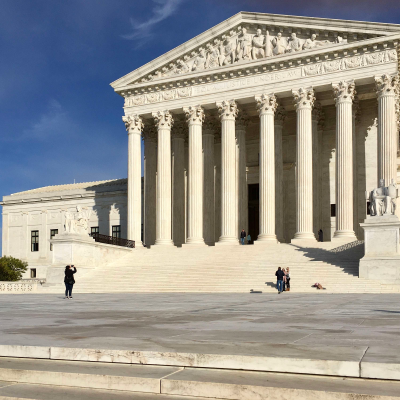
Following what the Supreme Court is actually doing can be daunting. Reporting on the subject is often only done within the context of political narratives of the day -- and following the Court's decisions and reading every new case can be a non-starter. The purpose of this Podcast is to make it as easy as possible for members of the public to source information about what is happening at the Supreme Court. For that reason, we read every Opinion Syllabus without any commentary whatsoever. Further, there are no advertisements or sponsors. We call it "information sourcing," and we hope that the podcast is a useful resource for members of the public who want to understand the legal issues of the day, prospective law students who want to get to know legal language and understand good legal writing, and attorneys who can use the podcast to be better advocates for their clients. *Note this podcast is for informational and educational purposes only.
Alle episoder
514 EpisoderClark v. Sweeney (Party Presentation)
Send us a text [https://www.buzzsprout.com/twilio/text_messages/154487/open_sms] In Clark v. Sweeney [https://www.supremecourt.gov/opinions/25pdf/25-52_4gd5.pdf], the Supreme Court reversed a Fourth Circuit decision that had granted habeas relief on a theory the petitioner never raised. A Maryland jury convicted Jeremiah Sweeney of second-degree murder, and his convictions were affirmed on appeal. In postconviction proceedings, Sweeney argued that trial counsel was ineffective for failing to request voir dire of the full jury after a juror conducted an unauthorized visit to the crime scene. State courts rejected that claim, and the federal district court likewise denied habeas relief, concluding that the state court’s application of Strickland was not objectively unreasonable. The Fourth Circuit reversed, not on the ineffective-assistance claim Sweeney actually asserted, but on a new theory that a combination of failures by the juror, the judge, and counsel violated Sweeney’s confrontation and jury rights. The panel ordered a new trial despite the State never having the opportunity to address that theory. A dissent criticized the majority for disregarding fundamental principles of party presentation. The Supreme Court held that the Fourth Circuit had “departed so drastically from the principle of party presentation as to constitute an abuse of discretion.” In the Court’s view, federal courts may not grant relief on claims the petitioner did not present and that the State had no chance to contest. The case is remanded for the Fourth Circuit to evaluate only the ineffective-assistance claim Sweeney actually pursued, under AEDPA’s deferential standards governing federal review of state adjudications of Strickland claims.
Pitts v. Mississippi (Confrontation Clause)
Send us a text [https://www.buzzsprout.com/twilio/text_messages/154487/open_sms] The United States Supreme Court reversed a decision of the Mississippi Supreme Court upholding the use of a physical screen that prevented a four-year-old child witness from seeing the defendant during trial. Mississippi law mandates the use of such screens for child witnesses in abuse cases. Relying on that statute, the trial court permitted the screen without taking evidence or making any case-specific finding that the arrangement was necessary to protect the witness. On review, the Mississippi Supreme Court concluded that the statute, combined with state constitutional victims’ rights provisions, distinguished the case from Coy v. Iowa and Maryland v. Craig, which require individualized findings before limiting face-to-face confrontation. The dissent argued that those precedents squarely controlled and that the trial court failed to comply with their requirements. The U.S. Supreme Court held that Coy and Craig govern: a deviation from face-to-face confrontation is permissible only after the trial court hears evidence and finds that testifying in the defendant’s presence would cause trauma that impairs the child’s ability to communicate. The mandatory nature of Mississippi’s statute could not substitute for those constitutional findings, and the trial court’s reliance on the statute alone was insufficient. The Court remanded for consideration of whether the Confrontation Clause violation was harmless beyond a reasonable doubt.
Goldey v. Field (Bivens / Excessive Force)
Send us a text [https://www.buzzsprout.com/twilio/text_messages/154487/open_sms] Goldey v. Fields [https://www.supremecourt.gov/opinions/24pdf/24-809_9o6b.pdf] PER CURIAM. In Bivens v. Six Unknown Fed. Narcotics Agents, 403 U. S. 388 (1971), this Court recognized an implied cause of action for damages against federal officers for certain alleged violations of the Fourth Amendment. The Court subsequently recognized two additional contexts where implied Bivens causes of action were permitted, neither of which was an Eighth Amendment excessive-force claim. After 1980, we have declined more than 10 times to extend Bivens to cover other constitutional violations. Those many post1980 Bivens “cases have made clear that, in all but the most unusual circumstances, prescribing a cause of action is a job for Congress, not the courts.” Egbert v. Boule, 596 U. S. 482, 486 (2022). Despite those precedents, the U. S. Court of Appeals for the Fourth Circuit permitted the plaintiff here to maintain an Eighth Amendment excessive-force Bivens claim for damages against federal prison officials. ... This Court has repeatedly emphasized that “recognizing a cause of action under Bivens is ‘a disfavored judicial activity.’” Egbert, 596 U. S., at 491. To determine whether a Bivens claim may proceed, the Court has applied a two-step test. First, the Court asks whether the case presents “a new Bivens context”—that is, whether the case “is different in a meaningful way” from the cases in which this Court has recognized a Bivens remedy. Ziglar v. Abbasi, 582 U. S. 120, 139 (2017); see Carlson v. Green, 446 U. S. 14 (1980); Davis v. Passman, 442 U. S. 228 (1979); Bivens, 403 U. S. 388. Second, if so, we then ask whether there are “special factors” indicating that “the Judiciary is at least arguably less equipped than Congress to ‘weigh the costs and benefits of allowing a damages action to proceed.’” Egbert, 596 U. S., at 492. That analysis is anchored in “separation-of-powers principles.” Ziglar, 582 U. S., at 135. This case arises in a new context, and “special factors” counsel against recognizing an implied Bivens cause of action for Eighth Amendment excessive-force violations. To begin with, Congress has actively legislated in the area of prisoner litigation but has not enacted a statutory cause of action for money damages. See Ziglar, 582 U. S., at 148– 149. In addition, extending Bivens to allow an Eighth Amendment claim for excessive force could have negative systemic consequences for prison officials and the “inordinately difficult undertaking” of running a prison. Turner v. Safley, 482 U. S. 78, 84–85 (1987). Moreover, “an alternative remedial structure” already exists for aggrieved federal prisoners. Ziglar, 582 U. S., at 137; see Correctional Services Corp. v. Malesko, 534 U. S. 61, 74 (2001). The existence of such alternative remedial procedures counsels against allowing Bivens suits even if such “procedures are ‘not as effective as an individual damages remedy.’” Egbert, 596 U. S., at 498. For the past 45 years, this Court has consistently declined to extend Bivens to new contexts. See Egbert, 596 U. S., at 490–491. We do the same here. The petition for certiorari is granted, the judgment of the U. S. Court of Appeals for the Fourth Circuit is reversed, and the case is remanded for further proceedings consistent with this opinion. It is so ordered.
Trump v. CASA, Inc. (Universal Injunction / Birthright Citizenship)
Send us a text [https://www.buzzsprout.com/twilio/text_messages/154487/open_sms] Trump v. CASA, Inc. [https://www.supremecourt.gov/opinions/24pdf/24a884_new2_0pl1.pdf] Held: Universal injunctions likely exceed the equitable authority that Congress has given to federal courts. The Court grants the Government’s applications for a partial stay of the injunctions entered below, but only to the extent that the injunctions are broader than necessary to provide complete relief to each plaintiff with standing to sue. Pp. 4– 26.
Kennedy v. Braidwood Management, Inc. (Appointments Clause)
Send us a text [https://www.buzzsprout.com/twilio/text_messages/154487/open_sms] Kennedy v. Braidwood Management, Inc. [https://www.supremecourt.gov/opinions/24pdf/24-316_869d.pdf] In 1984, the Department of Health and Human Services (HHS) created the U. S. Preventive Services Task Force, a body that formulates evidence-based recommendations regarding preventive healthcare services. Congress codified the Task Force’s role in 1999, establishing it as an entity within the Agency for Healthcare Research and Quality (AHRQ) in HHS’s Public Health Service. The Task Force currently consists of 16 volunteer members appointed by the Secretary of HHS to staggered 4-year terms. Before 2010, Task Force recommendations were purely advisory. The Affordable Care Act of 2010 changed this by requiring most health insurers and group health plans to cover without cost sharing those preventive services that receive “A” or “B” ratings from the Task Force. The Act also amended the governing statute to describe the Task Force as “independent” and to provide that members and their recommendations “shall be independent and, to the extent practicable, not subject to political pressure.” 42 U. S. C. §§299b–4(a)(1), (6). Plaintiffs, individuals and small businesses who object to the Affordable Care Act’s preventive-services coverage requirements, sued in federal court. Lead plaintiff Braidwood Management runs a health and wellness center offering insurance coverage to its approximately 70 employees through a self-insured plan. Plaintiffs argued that Task Force members are principal officers under the Appointments Clause who must be appointed by the President “with the Advice and Consent of the Senate,” Art. II, §2, cl. 2, not by the Secretary. The District Court agreed, recognizing that Task Force members are removable at will by the Secretary but concluding they are principal officers because they “have no superior” who supervises and directs them. 627 F. Supp. 3d 624, 646. While the Government’s appeal was pending, the Secretary in June 2023 ratified existing appointments made by the AHRQ Director and began personally appointing Task Force members. The Fifth Circuit affirmed the District Court, holding that while Task Force members are removable at will, they are not inferior officers because they cannot be “ ‘independent’ ” and “free from ‘political pressure’ ” while simultaneously being supervised by a political appointee. Held: Task Force members are inferior officers whose appointment by the Secretary of HHS is consistent with the Appointments Clause. Read by RJ Dieken.
Velg abonnementet ditt
Tidsbegrenset tilbud
Premium
20 timer lydbøker
Eksklusive podkaster
Gratis podkaster
Avslutt når som helst
1 Måned for 9 kr
Deretter 99 kr / Måned
Premium Plus
100 timer lydbøker
Eksklusive podkaster
Gratis podkaster
Avslutt når som helst
Prøv gratis i 14 dager
Deretter 169 kr / month
Bare på Podimo










Populære lydbøker
























1 Måned for 9 kr. Deretter 99 kr / Måned. Avslutt når som helst.