Economics Happy Hour Podcast
Englisch
Gratis en Podimo
Kostenlos hören bei Podimo
Starte jetzt und verbinde dich mit deinen Lieblingspodcaster*innen
- Vertraut von über 1 Mio. deutschen Hörer*innen
- Über 1.000 lokale Podcasts und Shows – nur bei Podimo
- Keine Zahlung nötig
Mehr Economics Happy Hour Podcast
A podcast & newsletter about two economists who love talking about all things economics. econhappyhour.substack.com
Alle Folgen
81 Folgen
Jobs That Didn't Exist 25 Years Ago
We reflect on what economics can teach us about work, technology, and the future. A new report by LinkedIn found that one in five Americans now work in jobs that didn’t exist in 2000. We consider the economic implications of new roles driven by technology, the gig economy, and changing workplace demands. We touch on the decline of now-obsolete jobs, and question how educators can help students prepare for an unpredictable employment future. In this episode, we discuss: * The surprising stat that 1 in 5 Americans have jobs that didn’t exist in 2000 * What kinds of new jobs have emerged in the past 25 years * The decline of older job types and industries, like video rental * How institutions and firms adapt to new tech by creating new roles * Teaching strategies to help students understand labor market changes * And a whole lot more! Catch up on some old episodes: You can also subscribe to us on Spotify [https://open.spotify.com/show/389F2dNBolWGdVg3fVaLgB], TuneIn Radio [https://tunein.com/podcasts/Business--Economics-Podcasts/Economics-Happy-Hour-p3520761/?topicId=267343270], Amazon Music [https://music.amazon.com/es-co/podcasts/3029d567-3081-4e4e-a9a2-5aa73f956eed/economics-happy-hour-podcast?referrer=https%3A%2F%2Fwww.google.com%2F], and Apple Podcasts [https://podcasts.apple.com/us/podcast/economics-happy-hour-podcast/id1680280857]. If one of these is your go-to podcast service, be sure to rate us and subscribe! Some show notes: We’re sitting down in the middle of December, which means our classes are nearly over. By the time you’re reading this, grades have been posted, and we likely have auto replies on our emails. Jadrian celebrates the end of the term with a Shiner Bock [https://www.beeradvocate.com/beer/profile/143/1352/] (Texas pride intact), while Matt braved a Mad Elf [https://troegs.com/beer/mad-elf/], with a water on standby. Our mystery stat game included estimates of holiday spending across the U.S. and Canada [https://explodingtopics.com/blog/christmas-spending-stats], and the motivation for today’s conversation: roughly 20% of Americans now work in jobs that didn’t exist 25 years ago [https://www.wsj.com/lifestyle/careers/youre-a-knowledge-architect-why-modern-careers-are-so-hard-to-explain-b0bc2407?gaa_at=eafs&gaa_n=AWEtsqfDxv-qoQwLUWcDLotusbfd6nbF-b6hFn6VYCc_xvvH4rExSVrewsmENOOLCfg%3D&gaa_ts=69442286&gaa_sig=ABeAgNSdqU-WmrsY4nOmT8dGwShxf2xvZmprSf6vc58jocyWXKbuGk-IXR0IgeEKfgj0evIE4I98sPWv5vhQbg%3D%3D]. That stat, based on LinkedIn data cited by The Wall Street Journal, set the stage for our discussion on how the economy has evolved over the past 25 years. It’s easy to spot the jobs that have emerged in recent years: prompt engineers, social media managers, app developers [https://blog.intostudy.com/uncategorized/20-jobs-that-didnt-exist-20-years-ago/]. Even long-standing institutions like universities now rely on roles in IT, marketing, and cybersecurity that simply didn’t exist 25 years ago. And beyond traditional workplaces, the gig economy has exploded, with Uber drivers, Instacart shoppers, and Grubhub couriers becoming a visible part of daily life. But there’s a flip side: jobs that fade away. One of the clearest examples is video rental, where employment dropped from over 120,000 in 2000 to fewer than 13,000 by 2017 [https://www.econlib.org/library/Enc/CreativeDestruction.html]. It’s a reminder that as technology and habits shift, entire industries can disappear. Students often struggle with this dual reality. New tech can destroy some jobs while creating others we couldn’t have predicted. The fear that automation will leave everyone unemployed reflects a common economic mistake: the lump-of-labor fallacy [https://www.investopedia.com/terms/l/lump-of-labour-fallacy.asp], or the idea that there’s a fixed number of jobs to go around. Labor market change can feel uncertain, even threatening. If 20% of today’s jobs didn’t exist a generation ago, what does that mean for the value of a college degree? For us, it reinforces the point: teaching students how to think, adapt, and collaborate may be the most reliable form of job security. Majors and tools will change, but curiosity, communication, and decision-making won’t be outdated anytime soon. Cheers, and happy holidays! This week’s pop culture references: Jadrian brought a fun throwback clip from a 1994 episode of [https://econ.video/2025/12/18/the-today-show-what-is-the-internet/]The Today Show [https://econ.video/2025/12/18/the-today-show-what-is-the-internet/], where the hosts puzzle over what the internet is and how email addresses work. It’s a great reminder of just how recent (and confusing) the digital age once felt. Matt shared a scene from Sunset Boulevard [https://broadwayeconomics.com/with-one-look-sunset-boulevard/]’s “With One Look,” [https://broadwayeconomics.com/with-one-look-sunset-boulevard/] where a former silent film star (Norma Desmond) reflects on losing her place in Hollywood. It’s a striking example of creative destruction. New technology (talking pictures) can erase entire careers, even for once-iconic stars. This is a public episode. If you would like to discuss this with other subscribers or get access to bonus episodes, visit econhappyhour.substack.com [https://econhappyhour.substack.com?utm_medium=podcast&utm_campaign=CTA_1]
Paternalism in the Classroom 🎓
College is often framed as the bridge between adolescence and adulthood, but how much should professors “step in” to guide student behavior along the way? In this episode, we dig into the economics of teaching choices: attendance policies, deadlines, nudges, and classroom rules. We reflect on how these decisions affect student outcomes and engagement, and whether support in the short run may come at the cost of long-run independence. In this episode, we discuss: * What paternalism looks like in college classrooms * Should attendance be required in higher education? * How paternalistic policies affect learning and engagement * Trade-offs between student freedom and faculty expectations * Whether “hand-holding” helps or hinders student success * And a whole lot more! Catch up on some old episodes: You can also subscribe to us on Spotify [https://open.spotify.com/show/389F2dNBolWGdVg3fVaLgB], TuneIn Radio [https://tunein.com/podcasts/Business--Economics-Podcasts/Economics-Happy-Hour-p3520761/?topicId=267343270], Amazon Music [https://music.amazon.com/es-co/podcasts/3029d567-3081-4e4e-a9a2-5aa73f956eed/economics-happy-hour-podcast?referrer=https%3A%2F%2Fwww.google.com%2F], and Apple Podcasts [https://podcasts.apple.com/us/podcast/economics-happy-hour-podcast/id1680280857]. If one of these is your go-to podcast service, be sure to rate us and subscribe! Some show notes: It’s early December, and the semester is just about coming to an end at Virginia Tech and Susquehanna. Jadrian opted for a Prickly Pear Fruit Beer from Shiner, while Matt went with a Voodoo Ranger Juice Force Hazy Imperial IPA [https://www.voodooranger.com/beer/juice-force] in a small 7.5 oz can. Matt’s was high in ABV but “efficient.” We kicked off this episode with a new game, and it might just become a regular segment. One of us brings a specific number from a recent news story, and the other has to guess what it represents. Jadrian chose a stat from a new survey on whether adults think college is worth the cost [https://www.nbcnews.com/politics/politics-news/poll-dramatic-shift-americans-no-longer-see-four-year-college-degrees-rcna243672], while Matt focused on gains in the S&P 500 [https://fortune.com/2025/11/29/stock-market-outlook-santa-claus-rally-sp500-forecast-8000-2026/]. Let us know what you thought of the segment in the comments! We’ve touched on paternalism before [https://econhappyhour.substack.com/p/why-is-it-tough-to-teach-students?utm_source=publication-search], but this felt like the right moment to give it a full episode. As the semester winds down, we naturally start asking which policies should stay and which should change next term. A lot of those decisions come down to how much we should shape student behavior. Take attendance, for example. Should professors require it, track it, and tie it to grades? Or is it enough to show up, teach well, and let students make their own choices? From there, we expand into a broader design challenge. Every classroom policy (e.g., attendance, phone or laptop bans [https://www.educationnext.org/should-professors-ban-laptops-classroom-computer-use-affects-student-learning-study/], email rules, assignment deadlines) is a lever that nudges behavior. Jadrian shares his use of Friday night deadlines as a way to protect students’ weekends and reduce procrastination. It’s a deliberate nudge that some students dislike at first but often come to value by the end of the course (he thinks!). Matt frames these choices as a kind of mechanism design problem [https://www.investopedia.com/terms/m/mechanism-design-theory.asp]: how do we build classes that support learning and accountability, without overwhelming students? And how do we balance short-term support with long-term independence? There’s also a practical question of whether being too hands-on now ends up leaving students unprepared for less flexible environments after graduation. We also zoom out to look at institutional choices, like Susquehanna’s common lunch hour on Tuesdays and Thursdays. That break in the schedule encourages students to eat, meet with faculty, and build community. Even small decisions like that carry a bit of paternalism baked in. We don’t land on a one-size-fits-all answer. But we agree on this: every classroom rule, even something as simple as a deadline or device policy, is an economic choice. Whether intentional or not, it shapes how students behave and what they learn about navigating structure. This week’s pop culture references: Jadrian passed on his pop culture pick this week to keep the conversation going about Susquehanna’s campus-wide lunch break. But Matt came prepared with a clip from Jadrian’s favorite show (Parks and Recreation [https://economicsofparksandrec.com/]) where Leslie Knope argues for a soda tax to reduce overconsumption in Pawnee. This is a public episode. If you would like to discuss this with other subscribers or get access to bonus episodes, visit econhappyhour.substack.com [https://econhappyhour.substack.com?utm_medium=podcast&utm_campaign=CTA_1]
The Economics of Beer
Behind every pint of beer is a surprisingly complex story about choices, local identity, supply chains, and a maze of regulations. This week, we sit down with Trey Malone of Purdue University to unpack the economics of beer. We talk about everything from tap lists and terroir to hop farmers, regulations, and what it really means to “buy local.” In this episode, we discuss: * How Trey’s research career evolved to include beer economics * The explosion of product variety in grocery stores and how beer exemplifies that * Why too many choices on a tap list can lower beer sales * How local identity and terroir shape demand for craft beer, hops, and cider. * What 110,000 regulatory restrictions reveal about entrepreneurship in the beer industry. * And a whole lot more! Catch up on some old episodes: You can also subscribe to us on Spotify [https://open.spotify.com/show/389F2dNBolWGdVg3fVaLgB], TuneIn Radio [https://tunein.com/podcasts/Business--Economics-Podcasts/Economics-Happy-Hour-p3520761/?topicId=267343270], Amazon Music [https://music.amazon.com/es-co/podcasts/3029d567-3081-4e4e-a9a2-5aa73f956eed/economics-happy-hour-podcast?referrer=https%3A%2F%2Fwww.google.com%2F], and Apple Podcasts [https://podcasts.apple.com/us/podcast/economics-happy-hour-podcast/id1680280857]. If one of these is your go-to podcast service, be sure to rate us and subscribe! Some show notes: After three years hosting a show titled “Economics Happy Hour”, we figured it was finally time to discuss the economics of beer. We thought it best to bring on an expert, Trey Malone, the Boehlje Endowed Chair for Managerial Economics in Agribusiness at Purdue University [https://agribusiness.purdue.edu/people/trey-malone/]. Our drink line-up for this episode was eclectic: Jadrian with a Maine Blueberry sour [https://www.totalwine.com/beer/specialty-styles/american-wild-ale/lone-pine-blueberry-sparkler/p/234588161], Matt with a Dogfishhead 90 Minute IPA [https://www.dogfish.com/drink/beer/90-minute-ipa], and Trey with a nostalgic Stroh’s [https://strohs-beer.com/]. Trey shared some of the background to his journey into economics and eventually research interest in the economics of the beer industry [https://scholar.google.com/citations?user=2StX6y4AAAAJ&hl=en], which grew out of broader questions about food marketing and product diversity. When he was born, grocery stores carried around 8,000 unique products, but that number is around 50,000 today. Beer, in particular, went from being dominated by a small number of similar-tasting brands to a vibrant, diverse craft beer landscape. That shift made it a great case study for exploring consumer preferences and market evolution. One of his key research findings when studying beer was that more choices aren’t always better for businesses. In a field experiment featuring a partnership with a local brewery, he was able to find that doubling the number of beers on tap actually [https://www.cambridge.org/core/journals/journal-of-wine-economics/article/abs/mitigating-choice-overload-an-experiment-in-the-us-beer-market/D54DB361E28A8A6BE217CC276AC4A490]reduced [https://www.cambridge.org/core/journals/journal-of-wine-economics/article/abs/mitigating-choice-overload-an-experiment-in-the-us-beer-market/D54DB361E28A8A6BE217CC276AC4A490] the likelihood that customers ordered one [https://www.cambridge.org/core/journals/journal-of-wine-economics/article/abs/mitigating-choice-overload-an-experiment-in-the-us-beer-market/D54DB361E28A8A6BE217CC276AC4A490], a classic case of choice overload. However, adding a small signal on the beer (like highlighting its rating or awards) restored demand by lowering search costs. Trey also talked about how supply chains and local identity shape consumer preferences. In Michigan, hop growers leaned into the concept of terroir and crafted narratives around their unique Chinook hops to build demand [https://onlinelibrary.wiley.com/doi/abs/10.1002/mde.3246], even in markets outside the state. His research on cider showed that “local” doesn’t always mean geographic proximity [https://www.cambridge.org/core/journals/journal-of-wine-economics/article/is-localness-about-distance-or-relationships-evidence-from-hard-cider/E49893BA9288F6839743C30A302A3DDA]. Instead, it’s tied to community identity. For example, many Detroit consumers prefer cider from Michigan’s Upper Peninsula—hundreds of miles away—over cider from Windsor, Ontario, just across the river. On the production side, Trey’s work also explores regulation in the beer industry. Using machine learning, he and his collaborators identified over 110,000 regulatory restrictions across the beer supply chain [https://onlinelibrary.wiley.com/doi/abs/10.1002/agr.21507]. While that sounds like a lot of red tape, the research finds that clear and consistent rules often help entrepreneurs more than vague or inconsistent policies. It turns out that beer is more than just a beverage. It’s a powerful case study for understanding how incentives, identity, and business decisions intersect across the economy. This week’s pop culture references: Jadrian yielded his time to Trey to hear more about his teaching-related scholarship. Trey shared two recent papers published in Applied Economics Teaching Resources. One explores how podcasts can be used for extension and outreach, especially in agricultural colleges, to build connections beyond the classroom [https://www.aetrjournal.org/volumes/volume-4-2022/volume-4-issue-2-june-2022/extension-education/on-the-strategic-creation-of-extension-and-outreach-content-in-a-new-media-environment]. The other applies the Ignatian Pedagogical Paradigm (IPP) to create a day-long event focused on Black, Indigenous, and People of Color (BIPOC) farm ownership [https://www.aetrjournal.org/volumes/volume-7-2025/volume-7-issue-3-june-2025/teaching-and-educational-methods/an-ignatian-pedagogical-approach-to-fostering-conversations-on-bipoc-farmland-ownership-through-film-screenings], developed within a college of agriculture at a midsouth university. Matt shared a quick analysis he did on how much Cheers character Norm Peterson likely spent on beer during his run on the show. It was a fun, light look at fictional bar tabs and a clever nod to this week’s beer theme. This is a public episode. If you would like to discuss this with other subscribers or get access to bonus episodes, visit econhappyhour.substack.com [https://econhappyhour.substack.com?utm_medium=podcast&utm_campaign=CTA_1]
Why Colleges Pay Millions to Fired Coaches
College football is big business. While universities often talk about tradition, rivalries, and student spirit, the finances tell a story of massive contracts, enormous buyouts, and constant leadership churn. This week, Matt and Jadrian explore the economics behind college football coach buyouts and ask why schools pay millions to people who they consider bad at their job. We explore what these buyouts say about incentives, risk, and market competition in college sports. In this episode, we discuss: * Why coach buyouts are structured the way they are and what they signal. * How risk, reputation, and recruiting drive buyout decisions. * The role of agents in inflating buyouts and securing job security. * How schools balance donor pressure, fan expectations, and contract costs. * And a whole lot more! Catch up on some old episodes: You can also subscribe to us on Spotify [https://open.spotify.com/show/389F2dNBolWGdVg3fVaLgB], TuneIn Radio [https://tunein.com/podcasts/Business--Economics-Podcasts/Economics-Happy-Hour-p3520761/?topicId=267343270], Amazon Music [https://music.amazon.com/es-co/podcasts/3029d567-3081-4e4e-a9a2-5aa73f956eed/economics-happy-hour-podcast?referrer=https%3A%2F%2Fwww.google.com%2F], and Apple Podcasts [https://podcasts.apple.com/us/podcast/economics-happy-hour-podcast/id1680280857]. If one of these is your go-to podcast service, be sure to rate us and subscribe! Some show notes: Both our universities are in the midst of course registration, which means students are simultaneously stressed about their current classes and determining the classes they’ll take next semester. That stress has spilled over to Jadrian and Matt, which meant it was a good time to sit down, have a drink, and talk about economics. Jadrian was able to enjoy a Shiner Light [https://shiner.com/beer/light-blonde/] from the great state of Texas (but purchased in North Carolina), while Matt opted for a non-alcoholic Bud Zero [https://us.budweiser.com/budweiser-zero]. This week’s episode looked at the structure and rationale of college football coach buyouts thanks to a recent article published in [https://www.wsj.com/sports/football/lsu-head-coach-auburn-brian-kelly-hugh-freeze-6964e5e3?gaa_at=eafs&gaa_n=AWEtsqdOFG0zvwYe3lfCHwa5YFX5DjuG-SASMXb0ZUrhZ0GM2a0JcFzgknho3O7xI0I%3D&gaa_ts=690c1408&gaa_sig=niPdb0kXgJUiO14igh3YTx723UudmUuIwjPWTpDLztX5F-6GdX1YGYzFCHB7Xj2_muspk_0GOf7fIG1_XhKpcA%3D%3D]The Wall Street Journal [https://www.wsj.com/sports/football/lsu-head-coach-auburn-brian-kelly-hugh-freeze-6964e5e3?gaa_at=eafs&gaa_n=AWEtsqdOFG0zvwYe3lfCHwa5YFX5DjuG-SASMXb0ZUrhZ0GM2a0JcFzgknho3O7xI0I%3D&gaa_ts=690c1408&gaa_sig=niPdb0kXgJUiO14igh3YTx723UudmUuIwjPWTpDLztX5F-6GdX1YGYzFCHB7Xj2_muspk_0GOf7fIG1_XhKpcA%3D%3D]. For those who haven’t heard, a lot of major college football programs are on the hook for multi-million dollar buyouts of their head football coaches—a payment owed if their employer fires them before their contract ends. Schools like Penn State, Louisiana State, and Florida all owe their most recent coaches more than $100 million combined in buyouts. But why? These high-profile buyouts aren’t just about poor performance. Sometimes, schools are willing to pay tens of millions to remove a coach simply because they’re not meeting expectations fast enough. Of course, they’re also there to disincentivize coaches from leaving for a better job. Buyouts, then, serve both as a penalty for early termination and a retention incentive. Schools can’t perfectly predict how a coach will perform, but large contracts and buyouts can signal confidence or act as a commitment device. It’s also worth considering the financial discipline of athletic departments and athletic directors, and whether these clauses represent a principal-agent problem [https://www.investopedia.com/terms/p/principal-agent-problem.asp] or a winner’s curse [https://www.investopedia.com/terms/w/winnerscurse.asp]. This week’s pop culture references: Neither Matt nor Jadrian had a pop culture tie-in this week, but Matt shared a classroom experiment related to the episode’s theme. In his game theory course, students bid on a jar of pennies worth $6.01. Most bids come in well below that. One student, however, bid just over $8 and won, perfectly illustrating the winner’s curse discussed earlier in the episode. This is a public episode. If you would like to discuss this with other subscribers or get access to bonus episodes, visit econhappyhour.substack.com [https://econhappyhour.substack.com?utm_medium=podcast&utm_campaign=CTA_1]
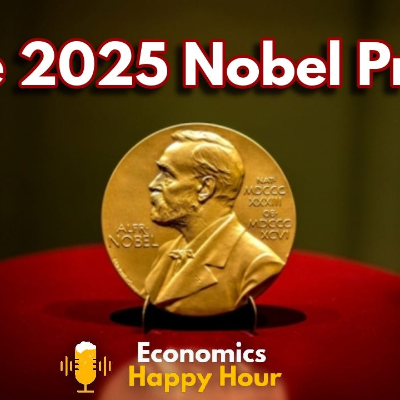
The 2025 Nobel Prize
We break down the 2025 Economics Nobel Prize, which was awarded to Joel Mokyr, Philippe Aghion, and Peter Howitt for their “having explained innovation-driven economic growth.” We discuss why these contributions matter and reflect on the broader importance of understanding long-term economic growth. Along the way, we also share our own reactions and what stood out about this year’s selection. In this episode, we discuss: * The 2025 Nobel Prize in Economics and how it was split among three researchers * Joel Mokyr’s work on the conditions needed for technological progress * Philippe Aghion and Peter Howitt’s model of creative destruction * The idea of the “hockey stick of growth” and what triggered the Industrial Revolution * Why understanding long-run growth matters in today’s economy * And a whole lot more! Catch up on some old episodes: You can also subscribe to us on Spotify [https://open.spotify.com/show/389F2dNBolWGdVg3fVaLgB], TuneIn Radio [https://tunein.com/podcasts/Business--Economics-Podcasts/Economics-Happy-Hour-p3520761/?topicId=267343270], Amazon Music [https://music.amazon.com/es-co/podcasts/3029d567-3081-4e4e-a9a2-5aa73f956eed/economics-happy-hour-podcast?referrer=https%3A%2F%2Fwww.google.com%2F], and Apple Podcasts [https://podcasts.apple.com/us/podcast/economics-happy-hour-podcast/id1680280857]. If one of these is your go-to podcast service, be sure to rate us and subscribe! Some show notes: It’s that time of semester where the the to-do lists seem to grow faster than our patience. But it also means that it’s Nobel Prize Week! To celebrate, Jadrian went with a non-alcoholic cucumber-watermelon refresher [https://fussfreeflavours.com/recipe-cucumber-watermelon-refresher/] since he was in the office. Matt, on the other hand, was able to crack open a New Trail Conifer Cosmos Hazy IPA [https://www.beeradvocate.com/beer/profile/52454/762915/]. This week’s episode centered on the 2025 Nobel Prize in Economic Sciences [https://www.nobelprize.org/prizes/economic-sciences/2025/press-release/], awarded to Joel Mokyr [https://www.nobelprize.org/prizes/economic-sciences/2025/mokyr/facts/], Philippe Aghion [https://www.nobelprize.org/prizes/economic-sciences/2025/aghion/facts/], and Peter Howitt [https://www.nobelprize.org/prizes/economic-sciences/2025/howitt/facts/] for their research on innovation-driven growth [https://www.nobelprize.org/prizes/economic-sciences/2025/summary/]. Mokyr received half the prize for explaining the prerequisites for sustained technological progress, while Aghion and Howitt shared the other half for their work on creative destruction [https://www.econlib.org/library/Enc/CreativeDestruction.html]. Mokyr’s work has been grounded in economic history, and highlights the importance of institutional and social foundations in sustaining technological progress. Aghion and Howitt’s model builds on Schumpeter’s idea of creative destruction, where innovation continuously disrupts old technologies and drives growth forward. There has been a great metaphor that often gets tossed around to describe modern growth: the “hockey stick” of economic growth [https://ourworldindata.org/economic-growth]. For centuries, global income remained largely flat until the Industrial Revolution, when technological advancement caused a steep rise in prosperity. Mokyr, Aghion, and Howitt’s work focused on the theoretical models that explained the dramatic turning point in history. It’s hard to overstate how vital these ideas are. Understanding growth may be the single most important question in economics. Both of us were familiar with the stories surrounding the hockey stick of growth, but neither of us were familiar with the three individuals who were selected. In no way is that a knock on the winners, but rather a highlight of the many subjects that economists study. Because there are so many topics to pick from, many economists tend to specialize in their frield. That makes it challenging to keep up with major work outside your own fields. This week’s pop culture references: Matt pointed out the lack of economic growth in Game of Thrones, noting that overhead shots of King’s Landing look nearly identical to those shown 200 years earlier in House of the Dragon. It’s a fun example of what it looks like when an economy doesn’t experience technological progress or creative destruction. It’s just the same buildings and no evidence of any hockey sticks. Jadrian grabbed a funny scene from Talladega Nights where Ricky Bobby claims that with modern medicine, he might live to be 245 years old. It’s a humorous take on how the technological progress studied by this year’s Nobel Laureates shapes expectations about the future. This is a public episode. If you would like to discuss this with other subscribers or get access to bonus episodes, visit econhappyhour.substack.com [https://econhappyhour.substack.com?utm_medium=podcast&utm_campaign=CTA_1]
Nur bei Podimo
























Beliebte Hörbücher