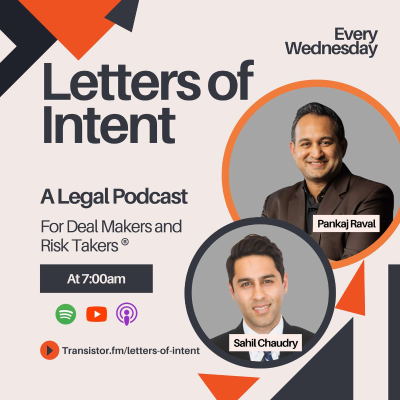
Letters of Intent
Englisch
Kostenlos bei Podimo
Kostenlos hören bei Podimo
Starte jetzt und verbinde dich mit deinen Lieblingspodcaster*innen
- Vertraut von über 1 Mio. deutschen Hörer*innen
- Über 1.000 lokale Podcasts und Shows – nur bei Podimo
- Keine Zahlung nötig
Mehr Letters of Intent
Conversations with business leaders and changemakers on how they built their business and what keeps them going.
Alle Folgen
61 Folgen
Disrupting the Box Office with AI Personalization
Is the movie theater industry actually dying, or is it just suffering from terrible, generic marketing? In this episode of Letters of Intent, Pankaj Raval and Sahil Chaudry are joined by Alvaro de la Cruz, a dynamic founder building Showlytics—an AI-powered personalization and analytics platform for movie theaters. Alvaro shares his incredible journey of pivoting from working on film sets in Hollywood to managing massive logistics operations at Cloud Kitchens, and how those experiences inspired him to solve a massive problem in the entertainment space. We dive deep into why legacy theater chains struggle with technology, how personalized, behavior-driven AI can drastically increase ticket sales for growing businesses, and the massive marketing mistakes major studios are currently making (like announcing streaming release dates too early). If you are interested in the intersection of entertainment, technology, and consumer behavior, this is a must-listen episode! Takeaways * The Pivot Mentality: Success is never a straight line. Having an end goal is crucial, but you must be willing to take detours, adapt to macroeconomic shifts, and learn new operational skills to eventually reach your desired destination. * Network Without an Agenda: If you want to break into a heavily gate-kept industry like Hollywood, don't ask for favors or funding right away. Ask for coffee, learn their story, and build a genuine friendship first. * The Problem is Awareness, Not Desire: People still want to go to the movies for an event-driven experience. The issue is decision fatigue and a lack of targeted awareness caused by an overwhelming amount of generic marketing. * Stop Announcing Streaming Dates: Studios are killing theatrical demand by immediately telling audiences when a film will be available at home. To drive box office revenue, theatrical exclusivity must remain a priority. * Make Life Easier, Don't Spam: True AI integration isn't about sending more generic emails; it's about predicting consumer habits (like booking times, seat preferences, and even weather patterns) to reduce friction and make the buying process seamless. Soundbites * "I have an end goal in mind of what I want to do with my life. But just like life, just like a story, you're not going to be able to get there in one shot." * "We're trying to make your life easier... We're not trying to spam you with more content. We're not trying to give you some more emails in your inbox." * "You need to stop telling the audience when the movie is coming out on streaming." * "AI will change things, it won't replace things." Keywords Showlytics, AI Personalization, Movie Theaters, Box Office Analytics, Entertainment Industry, Carbon Law Group, Business Growth, B2B Technology, Corporate Law 🔗 Learn More Website: carbonlg.com [https://carbonlg.com/] Connect with Pankaj: https://www.linkedin.com/in/pankaj-raval/ [https://www.linkedin.com/in/pankaj-raval/] Connect with Sahil: https://www.linkedin.com/in/sahil-chaudry-6047305/ [https://www.linkedin.com/in/sahil-chaudry-6047305/] Click Here To Schedule A Call With Us [https://app.acuityscheduling.com/schedule/39dbfd0e/category/Initial%2520Consultations%2520%252B%2520Inquiries/appointment/58485429/calendar/3429112]
Hidden Risks When Buying a Business: Due Diligence Explained
Acquiring a growing business sounds like a fast track to expansion, but if you don't know exactly what you are buying, you might just be purchasing someone else's debt. In this episode of Letters of Intent, Pankaj Raval and Sahil Chaudry break down the complex reality of small business acquisitions in the $1M to $10M range. They explain the critical legal differences between an asset purchase and a stock purchase, detailing when it is strategically wise to absorb an entity's history (and liabilities) to capture goodwill and vendor relationships. Sahil and Pankaj also dive into the due diligence process—highlighting exactly where sellers bury their "bodies," from padded EBITDA numbers and chaotic cap tables to retroactive labor compliance violations. Finally, they discuss the emotional psychology of deal-making and why buyers must ruthlessly ignore sellers who use "trust" to avoid hard questions. Takeaways * Asset vs. Stock: In an asset purchase, you are extracting the valuable pieces of a company (like IP or equipment) into a new container. In a stock purchase, you inherit the entire entity—meaning you gain their valuable goodwill and vendor history, but you also inherit all of their hidden liabilities and lawsuits. * Where Bodies are Buried: During the due diligence period, growing businesses must intensely scrutinize California labor compliance, hidden liens, and the true EBITDA. Sellers often run personal expenses (like cars or family health plans) through the company, artificially manipulating the profit margins. * Cap Table Chaos: Many small businesses have a mess of a cap table, handing out undocumented equity or profit interests. Buyers must ensure there is a clean chain of title for securities, real estate, and intellectual property. * The "Trust Me" Trap: If a seller tries to railroad you by saying, "We've known each other so long, don't you trust me?", walk away. Business acquisitions should be based on rational numbers, not emotional guilt-trips. * The Odyssey Analogy: As deal lawyers, Carbon Law Group acts like Odysseus's crew. Because founders are human and want to be accommodating, a lawyer's job is to tie the client to the mast and ensure they aren't lured into the rocks of a terrible deal. Soundbites * "The first question I ask them is, is this an asset purchase or is this a stock purchase? And those are two very different things." * "This is where you uncover where the bodies are buried." * "If someone talks like that, you shouldn't do this deal because those tactics usually mean somebody's lying and the numbers should speak for themselves." * "We're going to tie you to the mast if necessary to protect you." * "We are counsel for deal makers and risk takers, but not every deal is a good deal." Keywords Small Business Acquisitions, M&A, Asset Purchase, Stock Purchase, Due Diligence, EBITDA, Carbon Law Group, Business Strategy, Corporate Law. 🔗 Learn More Website: carbonlg.com [https://carbonlg.com/] Connect with Pankaj: https://www.linkedin.com/in/pankaj-raval/ [https://www.linkedin.com/in/pankaj-raval/] Connect with Sahil: https://www.linkedin.com/in/sahil-chaudry-6047305/ [https://www.linkedin.com/in/sahil-chaudry-6047305/] Click Here To Schedule A Call With Us [https://app.acuityscheduling.com/schedule/39dbfd0e/category/Initial%2520Consultations%2520%252B%2520Inquiries/appointment/58485429/calendar/3429112]
Navigating the MSA for Growing Businesses
"Management support" sounds like a collaborative and comforting phrase—until something goes wrong and nobody knows who is legally liable. In this episode of Letters of Intent, Pankaj Raval and Sahil Chaudry take a deep dive into Management Services Agreements (MSAs), specifically focusing on how they operate within the hospitality and healthcare sectors. They explore how small businesses and growing enterprises leverage MSAs to bring in operational expertise, from hotels utilizing third-party operators to healthcare clinics structuring "Friendly PC" models with Management Services Organizations (MSAs). Pankaj and Sahil break down the critical clauses every owner must fiercely negotiate, including decision-making authority, economic structures, regulatory compliance (like HIPAA), brand standards, and the crucial IP protections required if the relationship terminates. Takeaways * It is About Control, Not Just Support: An MSA doesn't just hire a vendor; it hands over the day-to-day operations of your business. If you do not clearly define the line between day-to-day authority and major strategic decisions, you risk losing control of your own enterprise. * The Franchise Risk: In hospitality, hiring a management company that is not approved by your franchisor can trigger a breach of contract, resulting in massive penalties and the potential loss of your flag. * The Friendly PC Model: In states like California that prohibit the corporate practice of medicine, MSAs are the critical legal bridge allowing non-physician investors to provide capital and administrative support to medical clinics through a Management Services Organization (MSO). * Contracts Require Controls: A beautifully drafted MSA means nothing if the ownership team becomes completely passive. Owners must actively oversee spending thresholds and operational metrics to ensure the management company isn't being loose with the purse strings. * Protect Your IP on Exit: When an MSA terminates, you must explicitly mandate that the management company cannot reverse-engineer your brand assets, SOPs, or customer data to use for competing clients. Soundbites * "Today we're talking about the management services agreement, which sounds helpful and collaborative until you realize it's really about control, money, liability, and whether someone quietly gave away half your business without noticing." * "I always talk about the importance of good contracts and good controls, and I think you have to have both for any successful business." * "Hospitality is where operational ambiguity becomes a Yelp review, then a claim, then a meeting everyone describes as productive, while internally everything's unraveling." * "If the contract doesn't clearly assign authority, responsibility, and risk, then the parties will do it later through conflict, which is almost always more expensive." * "Business management support is a comforting phrase right up until nobody knows who's liable." Keywords Management Services Agreement, MSA, Friendly PC Model, MSO, Hospitality Management, Healthcare Compliance, Carbon Law Group, Business Controls, Franchise Agreements. 🔗 Learn More Website: carbonlg.com [https://carbonlg.com/] Connect with Pankaj: https://www.linkedin.com/in/pankaj-raval/ [https://www.linkedin.com/in/pankaj-raval/] Connect with Sahil: https://www.linkedin.com/in/sahil-chaudry-6047305/ [https://www.linkedin.com/in/sahil-chaudry-6047305/] Click Here To Schedule A Call With Us [https://app.acuityscheduling.com/schedule/39dbfd0e/category/Initial%2520Consultations%2520%252B%2520Inquiries/appointment/58485429/calendar/3429112]
SPECIAL EPISODE - Structuring the Deal: Letters of Intent Explained
It’s the document that inspired the name of our show, and today, we are dedicating an entire episode to it. In this episode of Letters of Intent, Pankaj Raval and Sahil Chaudhary break down the critical importance of getting your LOI right before you ever look at a Purchase and Sale Agreement (PSA). They explore how a well-crafted LOI acts as a "movie trailer" for a deal, surfacing major disagreements and dealbreakers before either party spends thousands of dollars on legal fees or due diligence. Whether you are buying commercial real estate, selling a growing business, or bringing on new partners, Pankaj and Sahil walk you through the 10 essential terms every LOI needs, the dangers of seller financing, and the critical difference between binding and non-binding provisions. Takeaways * Don't Negotiate on a Handshake: Proceeding with due diligence without an LOI in place leaves you completely exposed. You can spend thousands of dollars inspecting a business or property, only for the seller to walk away with zero consequences. * The 10 Essential Terms: Price is just one factor. Your LOI must outline the deposit, due diligence period, closing date, exclusivity, financing contingencies, deal structure (asset vs. stock), key economic terms, closing conditions, and confidentiality. * Binding vs. Non-Binding: While the core economic terms of an LOI are generally non-binding, you must ensure that clauses protecting your process—like exclusivity, confidentiality, and breakup fees—are strictly binding. * Beware of Seller Financing: If a buyer is asking for seller financing, it often means a bank won't lend to them. Unless you are fully prepared to act as a bank and navigate a complex foreclosure process, proceed with extreme caution. * Bring Counsel in Early: The biggest mistake business owners make is handing their attorney an already-signed LOI. By bringing counsel in before signing, you can identify blind spots, secure leverage, and avoid being locked into unfavorable terms. Soundbites * "Three weeks of momentum and $8,000 gone, an LOI would have cost them an afternoon." * "Is an LOI kind of like a movie trailer? It gives you the highlights. It tells you, do you want to watch this movie?" * "Unless you're prepared to be the bank and try to foreclose and try to deal with the property and take back the property, you do not want that headache." * "The price is only one factor of a deal and you have to weigh that against many other factors." * "If there's one takeaway... you can't read the other person's mind. The biggest protection you have against making assumptions is the LOI." Keywords Letter of Intent, LOI, Mergers and Acquisitions, Commercial Real Estate, Business Acquisition, Term Sheet, Exclusivity, Due Diligence, Seller Financing, Carbon Law Group
The 100 to 100 Campaign: Carbon Law Group's New Initiative
Carbon Law Group is on a mission: to help 100 entrepreneurs and growing businesses reach the $100 million mark. Whether that means a $100 million exit, reaching a $100 million valuation, or generating $100 million in revenue, Pankaj Raval and Sahil Chaudry are dedicating this episode to unveiling the firm's ambitious new initiative. In this episode of Letters of Intent, Pankaj and Sahil discuss the legal barriers that often prevent small businesses from reaching "escape velocity." They break down why airtight contracts and rigorous controls are the non-negotiables of scaling. They also pull back the curtain on how Carbon Law Group is heavily investing in AI tools (like Lexis AI and Claude) to provide the strategic firepower of a 10-person legal team with unprecedented economic efficiency. Takeaways * The 100 to 100 Mission: Carbon Law Group is actively looking for hungry, coachable founders of growing businesses currently valued between $1M and $10M who want to scale to $100 million. * Contracts and Controls: To scale successfully, you need the proper legal infrastructure. This means having bulletproof Master Service Agreements (MSAs), Statements of Work (SOWs), and registered Intellectual Property to ensure you don't accumulate deal-killing liabilities as you grow. * AI is a Tool, Not a Lawyer: While tools like ChatGPT are incredibly powerful, they cannot replace a lawyer's trained ability to spot hidden risks, navigate complex human personalities in a negotiation, and map legal strategies to real-world business goals. * The Economic Efficiency of AI: By investing heavily in R&D and tools like Lexis AI, Claude, and Prompteteer, Carbon Law Group eliminates the bloated billing of traditional big law firms, doing the work of 10 lawyers with a highly efficient, technology-enabled team. * Entrepreneur-to-Entrepreneur: The best legal advice doesn't come from an academic vacuum. Pankaj and Sahil leverage their own experiences of managing employees and meeting sales targets to provide pragmatic, actionable counsel. Soundbites * "We want to make sure that you have the legal backbone and legal backing to make the right decisions, eliminate risk and get to that hundred million." * "You got to have great contracts, and you got to have great controls scaling your business." * "Honestly, if you have Chat GPT and you feel like that's your best lawyer, good luck. But the reality is, there's a lot more that goes into it than just what the AI can tell you." * "What would take 10 lawyers maybe three years ago, we can do with two to three." * "We know what it feels like to set targets and set sales targets and have to come up with the money to meet your expenses every month while chasing that big exit." Keywords SpaceX, xAI, Elon Musk, Section 368, Tax-Free Reorganization, Mergers and Acquisitions, Entire Fairness Rule, Corporate Governance, Fiduciary Duty, Pre-IPO Cleanup, Small Business Strategy, Carbon Law Group 🔗 Learn More Website: carbonlg.com [https://carbonlg.com/] Connect with Pankaj: https://www.linkedin.com/in/pankaj-raval/ [https://www.linkedin.com/in/pankaj-raval/] Connect with Sahil: https://www.linkedin.com/in/sahil-chaudry-6047305/ [https://www.linkedin.com/in/sahil-chaudry-6047305/] Click Here To Schedule A Call With Us [https://app.acuityscheduling.com/schedule/39dbfd0e/category/Initial%2520Consultations%2520%252B%2520Inquiries/appointment/58485429/calendar/3429112]
Nur bei Podimo
























Beliebte Hörbücher